Lot 723
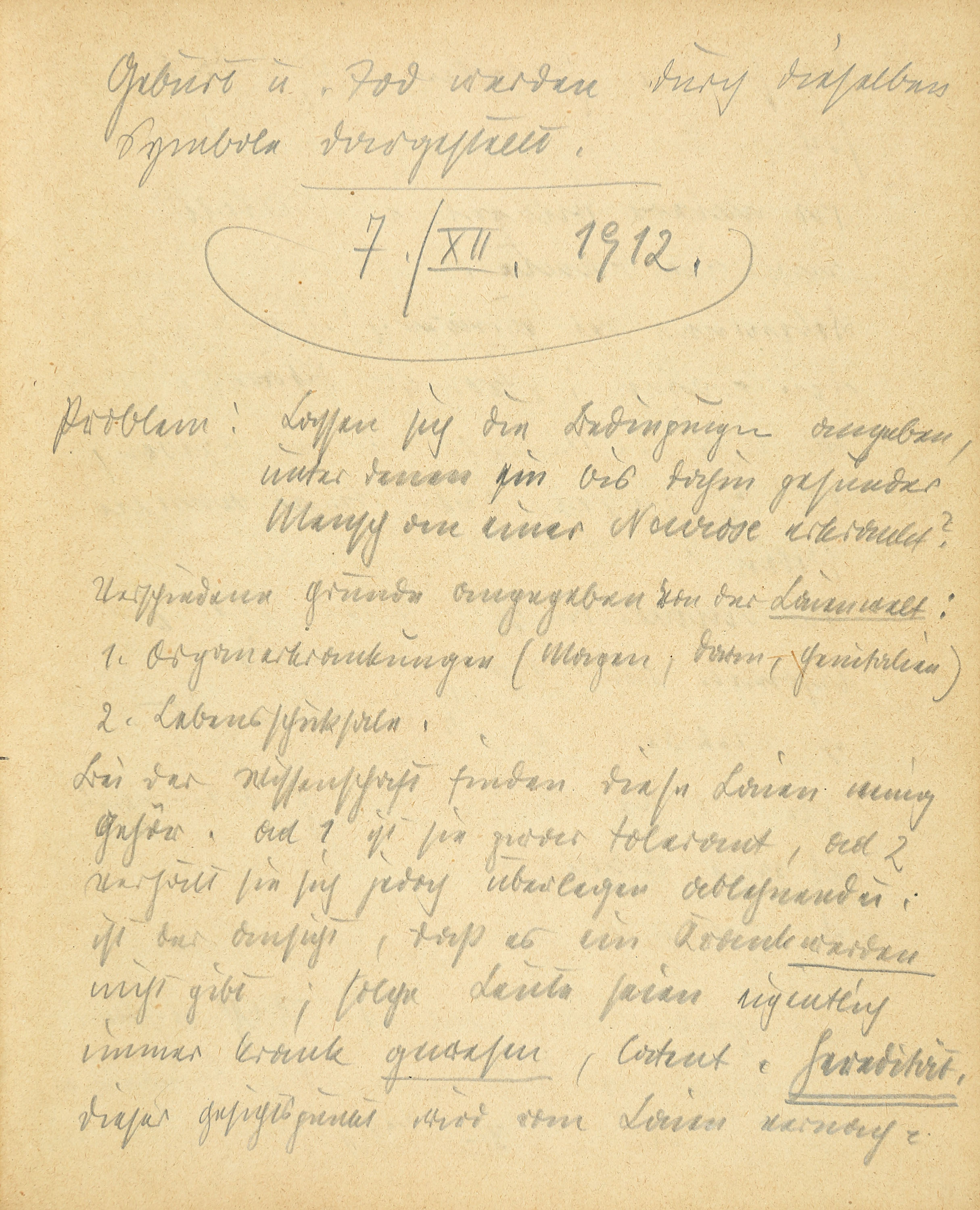
Sigmund Freud. – Vorlesungsmitschrift „Einzelne Kapitel aus der Lehre von der Psychoanalyse“. Wien 1912/13. Fragment.
Estimate
€ 750
Starting Price
€ 500
Hammer Price
€ 1.000
Lot:
723
Category:
Manuscripts and autographs
SIGMUND FREUD (1856 Freiberg in Mähren – 1939 London)
Begründer der Psychoanalyse
Transcript of the lecture ‘Einzelne Kapitel aus der Lehre von der Psychoanalyse’, delivered by Sigmund Freud at the University of Vienna during the winter semester of 1912/13. German manuscript in pencil on paper. 20.2 x 16.5 cm. 26 sheets. Staple-bound notebook with a linen spine and cover label.
(Stained and bumped. Cover with crease. 6 sheets detached from the binding and enclosed separately; marginal damage. One sheet with a large tear. Tarnished. Inside of the cover bearing the stamp of the Ministerial Secretary Karl Ritter von Pichler, Vienna.)
The digitally accessible course catalogue lists Freud’s lecture—he was then an associate professor—under the section ‘XVI. Psychiatrie’. The course took place on Saturdays from 7 to 9 o’clock in the lecture theatre of the psychiatric clinic, by prior personal registration only. The lecture was thus still institutionally assigned to the field of psychiatry, yet at the same time expressly dedicated to the then still nascent doctrine of psychoanalysis. – The present transcript comprises nine lecture sessions. The notes begin on 26 October 1912 with the methodological difficulties of psychoanalysis, including Freud’s call for self-analysis and the programmatic assertion that there is no science ‘für die der Mensch weniger geboren wäre, als die Psychoanalyse’. This is followed by the basic concepts of the unconscious, repression, the complex, resistance and the drive, followed by libido, ambivalence and introversion. Further lectures deal with symbolism and dream interpretation, a case of compulsive behaviour, the conditions for the development of a neurosis, the role of the libido in neurotic disorders, and the mechanisms of recovery. The last surviving session, dated 25 January 1913, deals explicitly with the therapeutic aspect of psychoanalysis. – The transcript reveals Freud not through a text that was later edited or intended for publication, but in the context of academic teaching, in which key concepts and clinical issues are developed and explained side by side. Statements such as ‘Neurotische Veränderungen sind Schicksale der Libido’ or the discussion that recovery is not achieved through the free expression of drives point to the dynamic, clinically oriented nature of psychoanalysis around 1912–13. – The chronological context is of particular interest. At this time, Freud was in a phase of intensive theoretical development and institutional consolidation of psychoanalysis. His lectures were also closely linked to the Vienna Circle of Psychoanalysis. Another point of interest is the question of whether Lou Andreas-Salomé attended this very lecture during her stay in Vienna in 1912–13. She stayed in Vienna from October 1912 to April 1913 and, during this time, attended Freud’s lectures as well as the meetings of the Vienna Psychoanalytical Society. Her notes, later published under the title ‘In der Schule bei Freud’, are among the best-known personal accounts of this Viennese world of teaching and discussion. Should it be confirmed that she attended this particular lecture, the present transcript would be regarded as an interesting counterpart to Andreas-Salomé’s subjective, reflective account: whilst her notes document her personal encounter with Freud and the impact of his teachings on a student, this notebook preserves the academic reception and direct transcription of the lecture content. The manuscript thus holds dual value as a source for research. On the one hand, it bears witness to the early history of the academic institutionalisation of psychoanalysis at the University of Vienna; on the other, it can serve as a historical record for reconstructing the material that Freud actually presented. As Freud did not publish his lectures in a regular, authorised printed edition, contemporary notes are particularly illuminating for research into the terminology, line of argument, examples and oral teaching methods of his psychoanalytic lectures. Such a source also allows for comparison with Freud’s published writings as well as with other contemporary accounts.
Enclosed with the notebook are 8 sheets of a typescript entitled ‘Salomes Tanz’.
Begründer der Psychoanalyse
Transcript of the lecture ‘Einzelne Kapitel aus der Lehre von der Psychoanalyse’, delivered by Sigmund Freud at the University of Vienna during the winter semester of 1912/13. German manuscript in pencil on paper. 20.2 x 16.5 cm. 26 sheets. Staple-bound notebook with a linen spine and cover label.
(Stained and bumped. Cover with crease. 6 sheets detached from the binding and enclosed separately; marginal damage. One sheet with a large tear. Tarnished. Inside of the cover bearing the stamp of the Ministerial Secretary Karl Ritter von Pichler, Vienna.)
The digitally accessible course catalogue lists Freud’s lecture—he was then an associate professor—under the section ‘XVI. Psychiatrie’. The course took place on Saturdays from 7 to 9 o’clock in the lecture theatre of the psychiatric clinic, by prior personal registration only. The lecture was thus still institutionally assigned to the field of psychiatry, yet at the same time expressly dedicated to the then still nascent doctrine of psychoanalysis. – The present transcript comprises nine lecture sessions. The notes begin on 26 October 1912 with the methodological difficulties of psychoanalysis, including Freud’s call for self-analysis and the programmatic assertion that there is no science ‘für die der Mensch weniger geboren wäre, als die Psychoanalyse’. This is followed by the basic concepts of the unconscious, repression, the complex, resistance and the drive, followed by libido, ambivalence and introversion. Further lectures deal with symbolism and dream interpretation, a case of compulsive behaviour, the conditions for the development of a neurosis, the role of the libido in neurotic disorders, and the mechanisms of recovery. The last surviving session, dated 25 January 1913, deals explicitly with the therapeutic aspect of psychoanalysis. – The transcript reveals Freud not through a text that was later edited or intended for publication, but in the context of academic teaching, in which key concepts and clinical issues are developed and explained side by side. Statements such as ‘Neurotische Veränderungen sind Schicksale der Libido’ or the discussion that recovery is not achieved through the free expression of drives point to the dynamic, clinically oriented nature of psychoanalysis around 1912–13. – The chronological context is of particular interest. At this time, Freud was in a phase of intensive theoretical development and institutional consolidation of psychoanalysis. His lectures were also closely linked to the Vienna Circle of Psychoanalysis. Another point of interest is the question of whether Lou Andreas-Salomé attended this very lecture during her stay in Vienna in 1912–13. She stayed in Vienna from October 1912 to April 1913 and, during this time, attended Freud’s lectures as well as the meetings of the Vienna Psychoanalytical Society. Her notes, later published under the title ‘In der Schule bei Freud’, are among the best-known personal accounts of this Viennese world of teaching and discussion. Should it be confirmed that she attended this particular lecture, the present transcript would be regarded as an interesting counterpart to Andreas-Salomé’s subjective, reflective account: whilst her notes document her personal encounter with Freud and the impact of his teachings on a student, this notebook preserves the academic reception and direct transcription of the lecture content. The manuscript thus holds dual value as a source for research. On the one hand, it bears witness to the early history of the academic institutionalisation of psychoanalysis at the University of Vienna; on the other, it can serve as a historical record for reconstructing the material that Freud actually presented. As Freud did not publish his lectures in a regular, authorised printed edition, contemporary notes are particularly illuminating for research into the terminology, line of argument, examples and oral teaching methods of his psychoanalytic lectures. Such a source also allows for comparison with Freud’s published writings as well as with other contemporary accounts.
Enclosed with the notebook are 8 sheets of a typescript entitled ‘Salomes Tanz’.