Lot 721
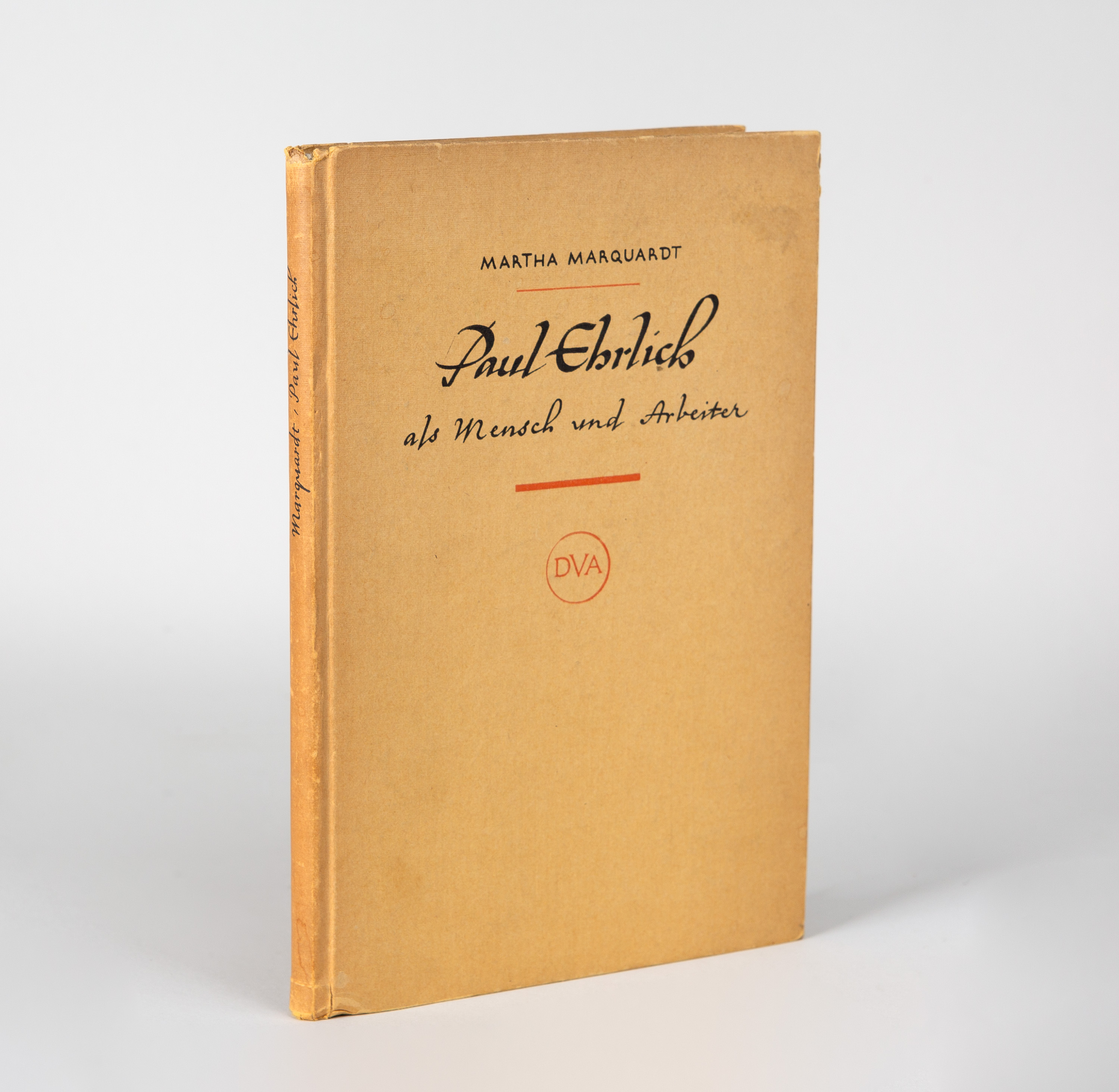
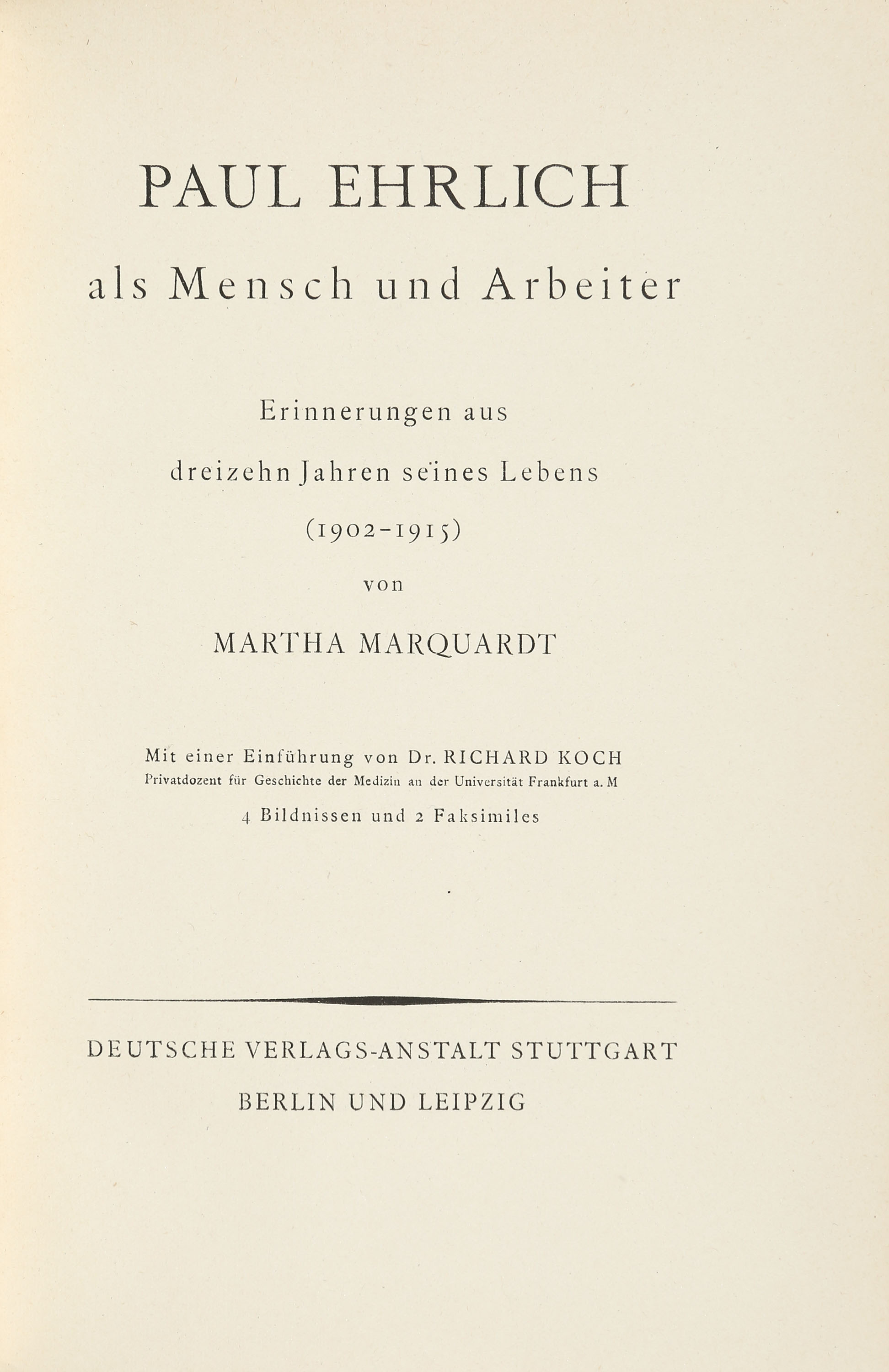
* Paul Ehrlich. 5 typewritten letters bearing his own signature (17 June 1910–17 November 1910). Bound into the book entitled „Paul Ehrlich als Mensch und Arbeiter“’.
Estimate
€ 3.000
Starting Price
€ 2.000
Hammer Price
€ 2.400
Lot:
721
Category:
Manuscripts and autographs
PAUL EHRLICH (1854 Strehlen – 1915 Bad Homburg)
Physician, discoverer of the first antibiotic and co-founder of modern chemotherapy
5 typewritten letters bearing his handwritten signature. 17 June 1910–17 November 1910; one letter is undated. Bound into the book Paul Ehrlich als Mensch und Arbeiter. Erinnerungen aus dreizehn Jahren seines Lebens (1902-1915)“ by Martha Marquardt (Berlin and Leipzig: Deutsche Verlags-Anstalt 1924). 22.4 x 15 cm. Original paperback with Dr Wilhelm Hauck’s bookplate, Bad Orb, on the front endpaper. The bookplate bears a handwritten dedication to Theo Nasemann.
(The cover is slightly scuffed at the corners and edges, the corners are slightly bumped, the spine is discoloured, there is a tiny moisture stain on the lower part of the spine, and a small tear at the spine joint. The letters are folded and mounted on top of one another along the top edge onto the endpaper at the back of the book. The first letter shows signs of discolouration. Overall, there are minor signs of ageing.)
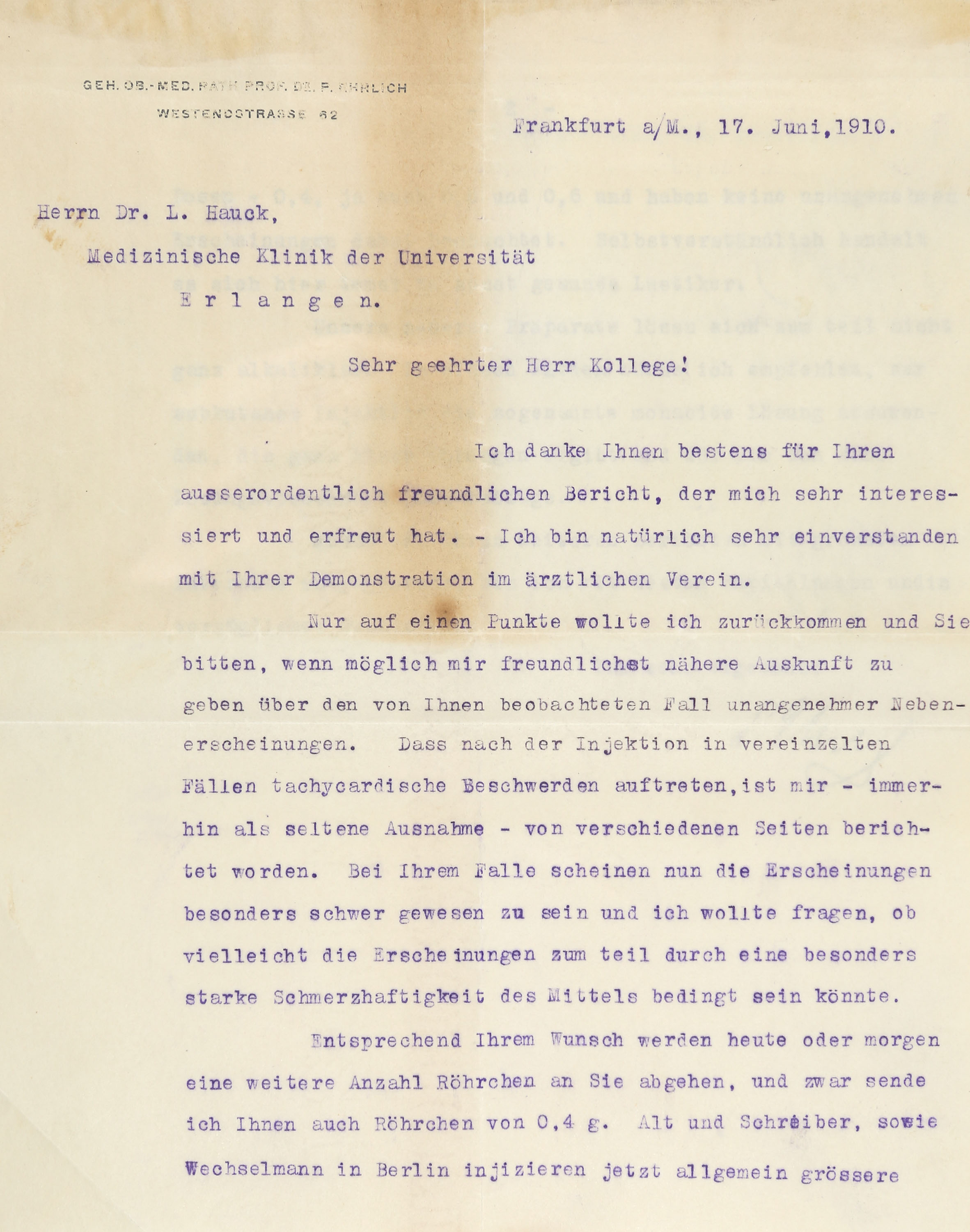
1) Typewritten letter with a handwritten signature. Frankfurt am Main, Westendstraße 62, 17 June 1910. 2 sheets. 25 x 20 cm. – To Johann Philipp Leonhardt Hauck, physician at Erlangen University Hospital. - Ehrlich requests further details regarding the case of unpleasant side effects observed by Hauck. Ehrlich is aware “dass nach der Injektion in vereinzelten Fällen tachycardische Beschwerden auftreten“; he suspects that the severity now observed is attributable to the particularly strong analgesic properties of the remedy. He announces that he will be sending preparations in higher doses and recommends “zur subkutanen Injektion die sogenannte monacide Lösung anzuwenden”, as the new preparations could not be fully dissolved in alkali. Ehrlich encloses a preparation instruction with the letter (not preserved).
2) Typewritten letter with a handwritten signature. Frankfurt am Main, Westendstraße 62, 25 June 1910. 1 sheet. With handwritten corrections. 24.5 x 20 cm. – To Hauck, whom he thanks for providing detailed medical histories. Ehrlich comments once again on the side effects described by Hauck: ,,Es ist mir doch zweifelhaft, ob in diesem Falle nicht zu einem Theil das auslösende Moment in einer atarken Nervenreizung durch die Injektion gelegen hat. Insbesondere möchte ich die klonischen Zuckungen in den Beinen auf eine lokale Nervenreizung durch die Injektionsflüssigkeit zurückführen. - Wie dem auch sei, solche Fälle sind es eben, die mich verhindern, das Mittel jetzt schon für ambulatorische Behandlung verwenden zu lassen. Wenn ein solcher Unglücksfall einmal auf der Strasse passieren und der Patient verunglücken sollte, so würde dadurch sofort das Mittel diskreditiert werden“
3) Typewritten letter with a handwritten signature. Frankfurt am Main, Georg Speyer-Haus, 15 July 1910. 1 sheet. 25 x 20 cm. – To Hauck. - Ehrlich asks for feedback on experiences with Preparation 606 für die Zusammenstellung einer Liste’. Hauck is asked to contact Ehrlich regarding the supply of new material, as he is ‘momentan infolge der kolossalen Nachfrage etwas Mangel’.
4) A typewritten letter bearing a handwritten signature. Frankfurt am Main, Georg Speyer-Haus, 17 November 1910. 2 sheets. With handwritten corrections. 25 x 20 cm. – To Hauck, who had in the meantime switched to intravenous treatment. Ehrlich attributes relapses in the treatment of syphilis primarily to the inappropriate administration of ‘606’. Subcutaneous administration, in particular, leads to insufficient absorption and thus fails to produce a lasting effect. He hopes that an intravenous injection, to be repeated after three to four weeks, will yield better results in terms of relapses and the Wassermann test. A standardised treatment regimen is not yet possible; rather, therapy must be individually tailored to the severity of each case and, where necessary, intensified. Ehrlich considers intensive treatment to be essential, particularly in cases of recent primary and secondary syphilis, in order to prevent dangerous relapses, especially neurological relapses.
5) Fragment of a typewritten letter bearing a handwritten signature. 2 (of 4) sheets (numbered 3 and 4; the first two sheets are missing). – Presumably addressed to Hauck. - Regarding side effects of the preparation: ‘Ich glaube daher, dass das Mittel in den obigen Dosen nicht als gefährlich bezeichnet werden kann - sicher nicht gefährlicher wie bestimmte vielfach angewandte Quecksilberpräparate, z.B. das ‚graue Oel‘. Auf jeden Fall scheint es mir daher angezeigt, zurzeit nur Fälle zu behandeln, die sich in Krankenhauspflege befinden, und die Methode vorerst nicht in der Privatpraxis oder bei ambulantem, poliklinischem Material in Anwendung zu ziehen. Ein Nachteil des Mittels ist die große Schmerzhaftigkeit der Injektion’. However, Ehrlich also reports great success with its use.
Documentation of the early clinical trials of the groundbreaking compound ‘606’ (Salvarsan), with which Paul Ehrlich set a decisive milestone in the history of chemotherapy. First used clinically on a large scale in 1910, the compound – developed within the Institute for Experimental Therapy in Frankfurt, founded by Ehrlich – was regarded as the first chemotherapeutic substance specifically developed to target a pathogen and was used in particular for the treatment of syphilis. In correspondence with the Erlangen-based physician Johann Philipp Leonhardt Hauck, Ehrlich discusses in detail side effects, dosage and routes of administration, evaluates medical records and refines his therapeutic recommendations directly on the basis of the clinical experience gained. The letters vividly convey the challenges of early Salvarsan therapy. The oxygen-sensitive preparation was labour-intensive to handle: it had to be stored in conditions with as little air as possible and, prior to injection, first dissolved or neutralised with caustic soda and then prepared for use with saline solution. The precise and timely preparation this required, along with the painful injection and potential adverse reactions, made careful medical supervision essential. Ehrlich therefore expressly warns against hasty outpatient use and initially advocates treatment in an inpatient setting. At the same time, the letters document the rapid success and enormous demand for the new drug: Ehrlich already speaks of a ‘colossal’ need and discusses intravenous administration as a more promising method for reducing the insufficient absorption associated with subcutaneous administration and the resulting relapses. The direct insight into a decisive moment in modern drug therapy is thus of particular significance in the history of science and medicine: the letters reveal Salvarsan not only as a medical innovation, but also show its development and testing within a concrete clinical dialogue, highlighting both Ehrlich’s experimental and pragmatic approach to his work and his strong sense of responsibility towards the patients he treated.
Physician, discoverer of the first antibiotic and co-founder of modern chemotherapy
5 typewritten letters bearing his handwritten signature. 17 June 1910–17 November 1910; one letter is undated. Bound into the book Paul Ehrlich als Mensch und Arbeiter. Erinnerungen aus dreizehn Jahren seines Lebens (1902-1915)“ by Martha Marquardt (Berlin and Leipzig: Deutsche Verlags-Anstalt 1924). 22.4 x 15 cm. Original paperback with Dr Wilhelm Hauck’s bookplate, Bad Orb, on the front endpaper. The bookplate bears a handwritten dedication to Theo Nasemann.
(The cover is slightly scuffed at the corners and edges, the corners are slightly bumped, the spine is discoloured, there is a tiny moisture stain on the lower part of the spine, and a small tear at the spine joint. The letters are folded and mounted on top of one another along the top edge onto the endpaper at the back of the book. The first letter shows signs of discolouration. Overall, there are minor signs of ageing.)
1) Typewritten letter with a handwritten signature. Frankfurt am Main, Westendstraße 62, 17 June 1910. 2 sheets. 25 x 20 cm. – To Johann Philipp Leonhardt Hauck, physician at Erlangen University Hospital. - Ehrlich requests further details regarding the case of unpleasant side effects observed by Hauck. Ehrlich is aware “dass nach der Injektion in vereinzelten Fällen tachycardische Beschwerden auftreten“; he suspects that the severity now observed is attributable to the particularly strong analgesic properties of the remedy. He announces that he will be sending preparations in higher doses and recommends “zur subkutanen Injektion die sogenannte monacide Lösung anzuwenden”, as the new preparations could not be fully dissolved in alkali. Ehrlich encloses a preparation instruction with the letter (not preserved).
2) Typewritten letter with a handwritten signature. Frankfurt am Main, Westendstraße 62, 25 June 1910. 1 sheet. With handwritten corrections. 24.5 x 20 cm. – To Hauck, whom he thanks for providing detailed medical histories. Ehrlich comments once again on the side effects described by Hauck: ,,Es ist mir doch zweifelhaft, ob in diesem Falle nicht zu einem Theil das auslösende Moment in einer atarken Nervenreizung durch die Injektion gelegen hat. Insbesondere möchte ich die klonischen Zuckungen in den Beinen auf eine lokale Nervenreizung durch die Injektionsflüssigkeit zurückführen. - Wie dem auch sei, solche Fälle sind es eben, die mich verhindern, das Mittel jetzt schon für ambulatorische Behandlung verwenden zu lassen. Wenn ein solcher Unglücksfall einmal auf der Strasse passieren und der Patient verunglücken sollte, so würde dadurch sofort das Mittel diskreditiert werden“
3) Typewritten letter with a handwritten signature. Frankfurt am Main, Georg Speyer-Haus, 15 July 1910. 1 sheet. 25 x 20 cm. – To Hauck. - Ehrlich asks for feedback on experiences with Preparation 606 für die Zusammenstellung einer Liste’. Hauck is asked to contact Ehrlich regarding the supply of new material, as he is ‘momentan infolge der kolossalen Nachfrage etwas Mangel’.
4) A typewritten letter bearing a handwritten signature. Frankfurt am Main, Georg Speyer-Haus, 17 November 1910. 2 sheets. With handwritten corrections. 25 x 20 cm. – To Hauck, who had in the meantime switched to intravenous treatment. Ehrlich attributes relapses in the treatment of syphilis primarily to the inappropriate administration of ‘606’. Subcutaneous administration, in particular, leads to insufficient absorption and thus fails to produce a lasting effect. He hopes that an intravenous injection, to be repeated after three to four weeks, will yield better results in terms of relapses and the Wassermann test. A standardised treatment regimen is not yet possible; rather, therapy must be individually tailored to the severity of each case and, where necessary, intensified. Ehrlich considers intensive treatment to be essential, particularly in cases of recent primary and secondary syphilis, in order to prevent dangerous relapses, especially neurological relapses.
5) Fragment of a typewritten letter bearing a handwritten signature. 2 (of 4) sheets (numbered 3 and 4; the first two sheets are missing). – Presumably addressed to Hauck. - Regarding side effects of the preparation: ‘Ich glaube daher, dass das Mittel in den obigen Dosen nicht als gefährlich bezeichnet werden kann - sicher nicht gefährlicher wie bestimmte vielfach angewandte Quecksilberpräparate, z.B. das ‚graue Oel‘. Auf jeden Fall scheint es mir daher angezeigt, zurzeit nur Fälle zu behandeln, die sich in Krankenhauspflege befinden, und die Methode vorerst nicht in der Privatpraxis oder bei ambulantem, poliklinischem Material in Anwendung zu ziehen. Ein Nachteil des Mittels ist die große Schmerzhaftigkeit der Injektion’. However, Ehrlich also reports great success with its use.
Documentation of the early clinical trials of the groundbreaking compound ‘606’ (Salvarsan), with which Paul Ehrlich set a decisive milestone in the history of chemotherapy. First used clinically on a large scale in 1910, the compound – developed within the Institute for Experimental Therapy in Frankfurt, founded by Ehrlich – was regarded as the first chemotherapeutic substance specifically developed to target a pathogen and was used in particular for the treatment of syphilis. In correspondence with the Erlangen-based physician Johann Philipp Leonhardt Hauck, Ehrlich discusses in detail side effects, dosage and routes of administration, evaluates medical records and refines his therapeutic recommendations directly on the basis of the clinical experience gained. The letters vividly convey the challenges of early Salvarsan therapy. The oxygen-sensitive preparation was labour-intensive to handle: it had to be stored in conditions with as little air as possible and, prior to injection, first dissolved or neutralised with caustic soda and then prepared for use with saline solution. The precise and timely preparation this required, along with the painful injection and potential adverse reactions, made careful medical supervision essential. Ehrlich therefore expressly warns against hasty outpatient use and initially advocates treatment in an inpatient setting. At the same time, the letters document the rapid success and enormous demand for the new drug: Ehrlich already speaks of a ‘colossal’ need and discusses intravenous administration as a more promising method for reducing the insufficient absorption associated with subcutaneous administration and the resulting relapses. The direct insight into a decisive moment in modern drug therapy is thus of particular significance in the history of science and medicine: the letters reveal Salvarsan not only as a medical innovation, but also show its development and testing within a concrete clinical dialogue, highlighting both Ehrlich’s experimental and pragmatic approach to his work and his strong sense of responsibility towards the patients he treated.