Lot 716
An album amicorum from Berlin’s artistic and intellectual circles during the Imperial era and the Weimar Republic, containing handwritten entries, drawings, watercolours and prints, 1892–1935.
Estimate
€ 10.000
Starting Price
€ 8.000
Lot:
716
Category:
Manuscripts and autographs
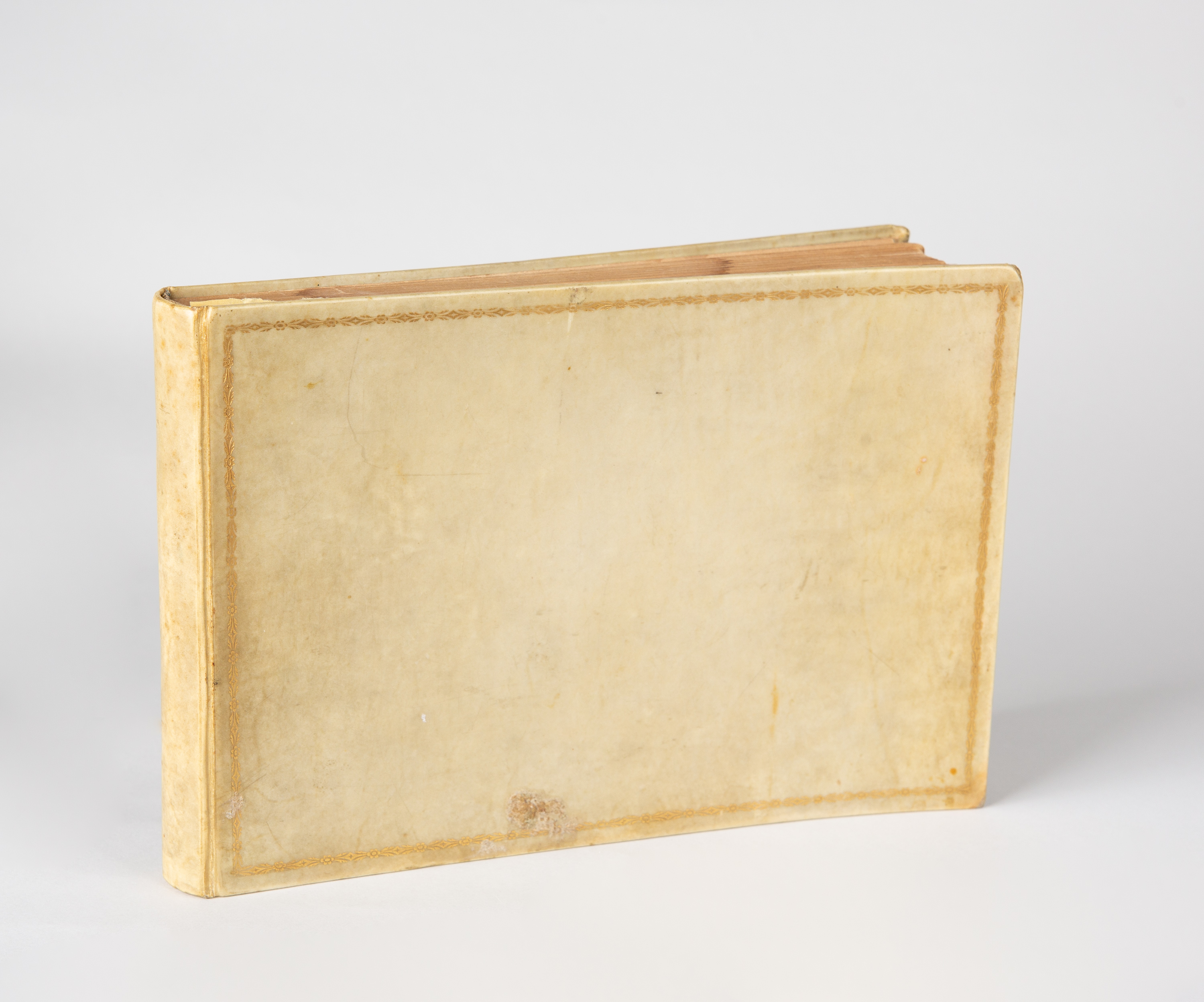
An album amicorum from Berlin’s artistic and intellectual circles during the Imperial era and the Weimar Republic, containing handwritten entries, drawings, watercolours and prints, 1892–1935. 16.3 x 23.2 cm. Paperback with a gold-embossed border on the cover.
(Rubbed and slightly spotted. A small defect on the front cover. The front cover is warped. The pages are damp-stained throughout, browned and have water-stains in places. Some of the original illustrations have come loose from their mountings and are enclosed separately; some have minor damage to the edges.)
The album provides an unusually detailed account of a personal network of artists, writers, musicians and public figures that developed over several decades. The contributors are largely drawn from Berlin’s artistic and intellectual circles at the turn of the century and during the Weimar Republic, including the wider circle associated with the Berlin Secession. Those represented include, amongst others, George Masson, Wolf Röhricht, Rudolf Hellwag, Julie Wolfthorn, Lovis Corinth, Theodor Heuss, Siegfried Ochs, Max Halbe, Kurt Harald Isenstein and Edvard Frank. The contributions range from handwritten dedications and literary quotations, through musical notations, to watercolours, drawings and prints. The album is therefore of interest not only as a collection of autographs and original works, but also as a rare testament to the close interconnection between the visual arts, literature, music and social life in Berlin during the Imperial era and the Weimar Republic.
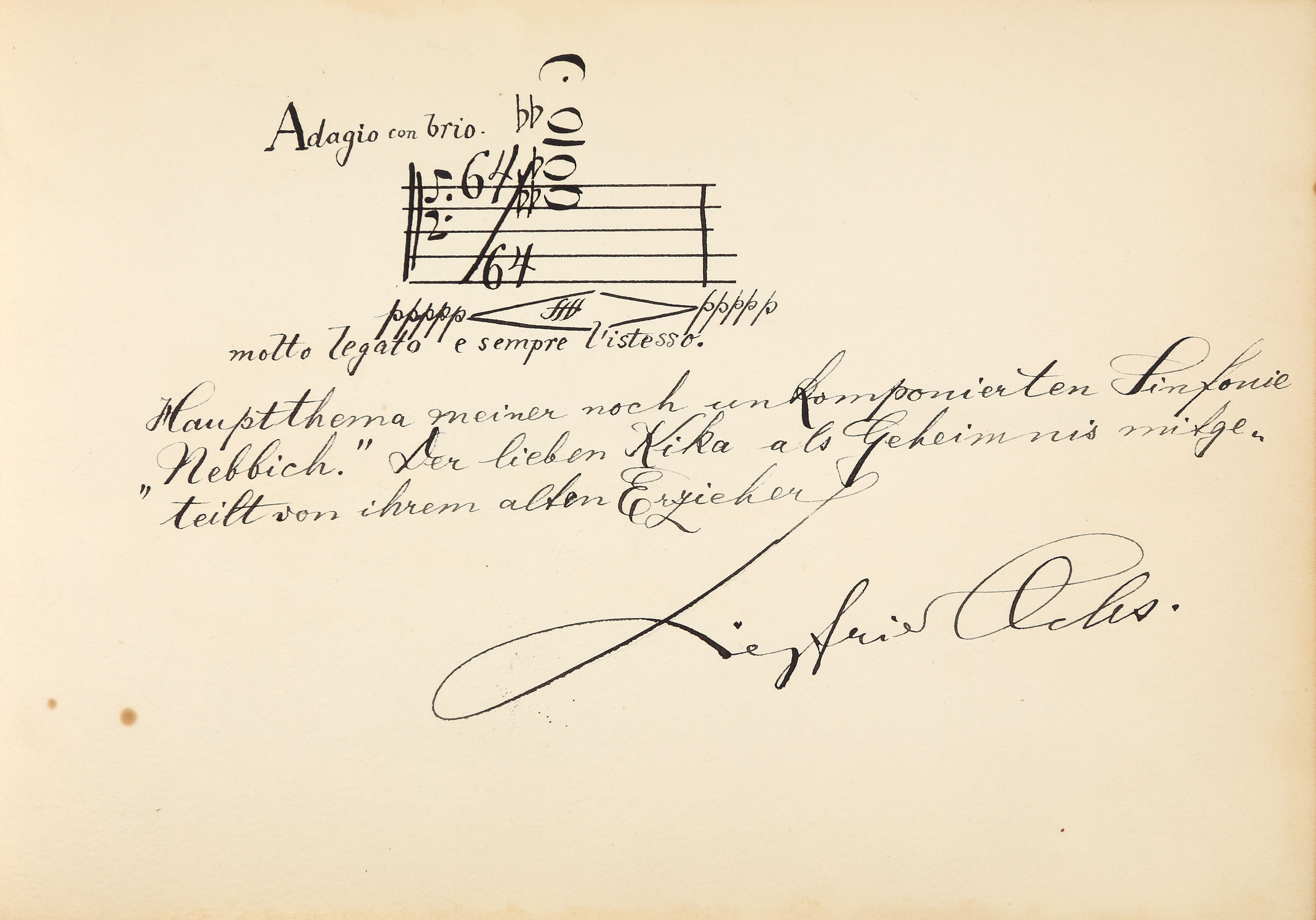
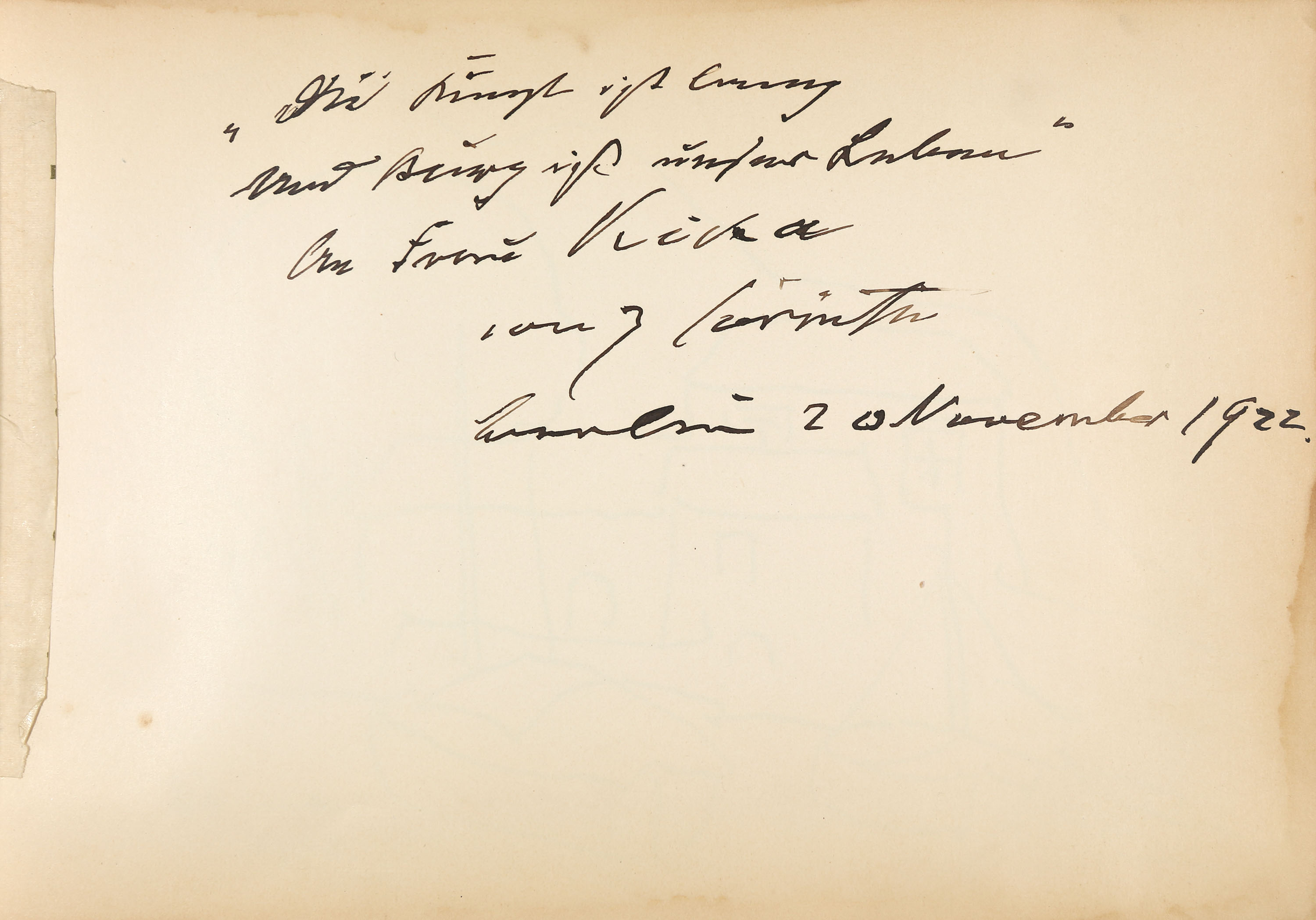
Of particular significance are the repeated addresses to a ‘Frau Kika’ or ‘dear Kika’. As far as is currently known, her identity has not been conclusively established. Particularly revealing is the undated entry by the composer Siegfried Ochs, who entrusted ‘his dear Kika’ with the main theme of his then-uncomposed symphony ‘Nebbich’ as a personal ‘secret’ and described himself as the addressee’s ‘old tutor’. Lovis Corinth, too, explicitly dedicated his entry—made in Berlin on 20 November 1922—to ‘Mrs Kika’, as did Theodor Heuss with one of the works contained in the album. Furthermore, there are several notable references to the circle of Ferdinand Mainzer (1871–1943) that shed light on the album’s provenance. On the reverse of a postcard in the album featuring a watercolour by Wolf Röhricht is the address ‘Frau Dr. Mainzer’ (Winterfeldtstr. 5–6, Berlin). The recipient is thought to be Gertrud Mainzer, née Sabersky, the wife of Ferdinand Mainzer. However, it is not possible to identify her with certainty on the basis of this clue alone. Of particular significance, too, is the handwritten note ‘from Ferdinand Mainzer’s home town’ on the reverse of a charcoal drawing by Theodor Heuss. Heuss had a personal connection with Ferdinand Mainzer; at the same time, Mainzer was deeply involved in Berlin’s cultural and intellectual life. Gertrud Mainzer, too, was closely connected to Berlin’s art scene and, as a pupil of Walter Leistikow, had a direct link to the Berlin art world; Lovis Corinth painted portraits of both her and Ferdinand Mainzer. Taken together, these clues provide a plausible provenance trail leading to the Mainzer family circle, although this does not currently allow for a definitive identification of the ‘Frau Kika’ mentioned several times in the album as Gertrud Mainzer. The possibility of a provenance linked to the Mainzer family circle therefore appears plausible; however, it should currently be understood explicitly as a well-founded but not conclusively confirmed hypothesis.
Taken as a whole, the album is to be understood as a stand-alone cultural-historical document of a Berlin network. Its significance lies not only in the prominent list of contributors, but also in the direct visibility of personal relationships:
Original works of art appear alongside private dedications, literary quotations and musical ideas. The album thus preserves an unusually direct snapshot of the social fabric of Berlin Modernism, whilst at the same time revealing the continuity of personal and cultural connections across the turning points of the German Empire, the First World War and the Weimar Republic.
Works included, in the order they appear in the album:
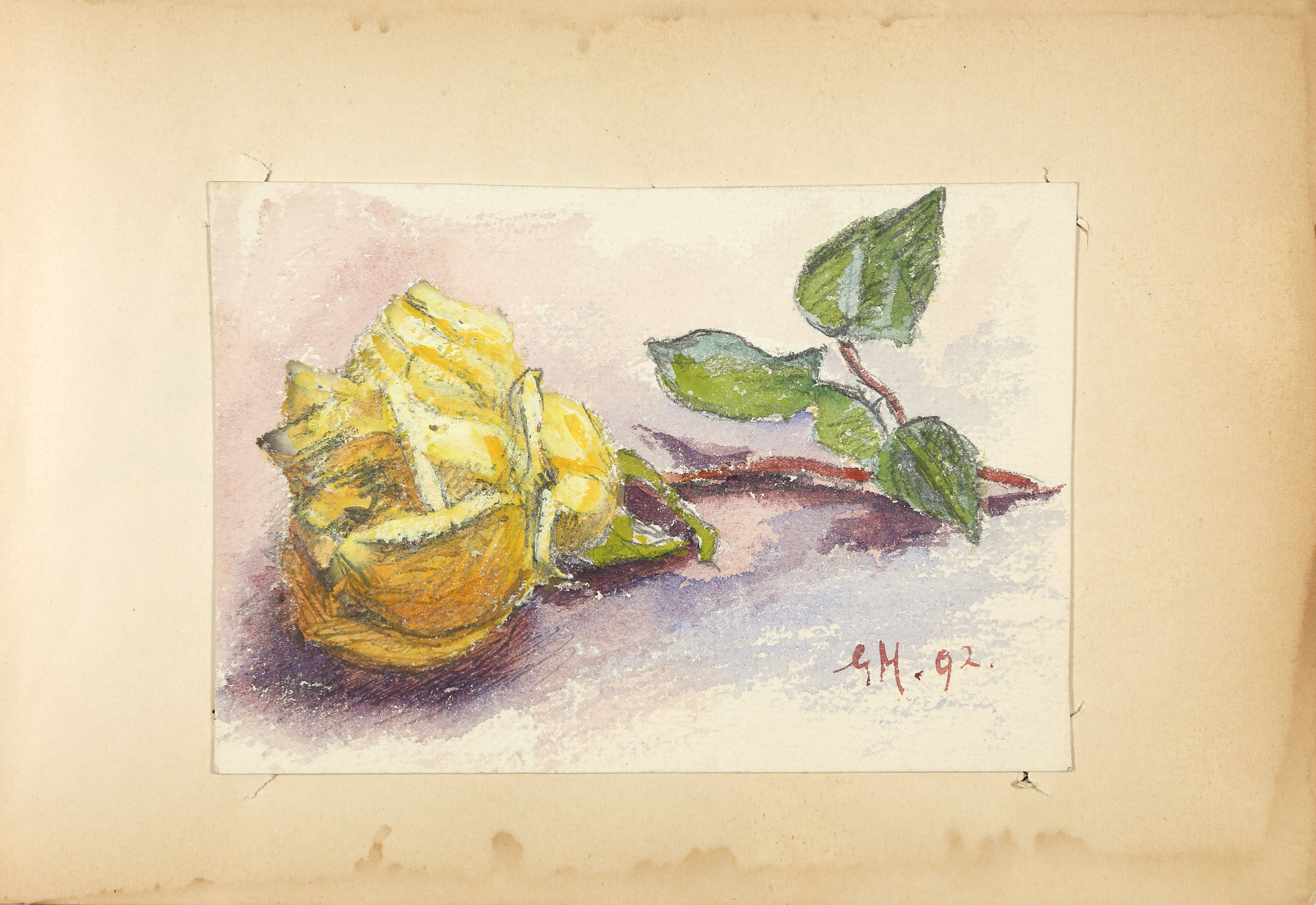
1) George Masson. Watercolour and pencil. 1892. Monogrammed.
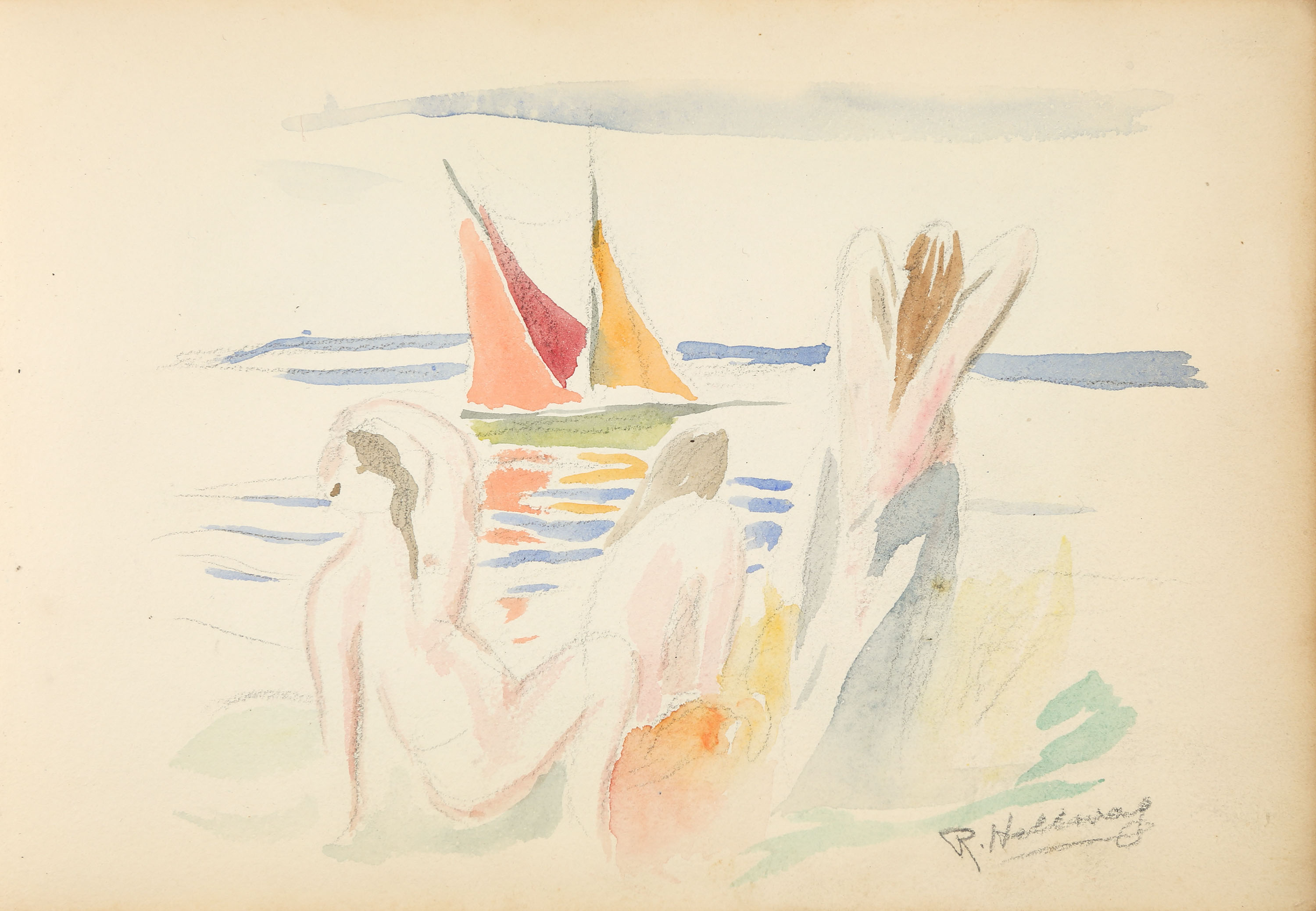
2) Wolf Röhricht. Watercolour, ink and pencil. Signed.
3) Rudolf Hellwag. Watercolour and pencil. Signed.
4) George Masson. Watercolour and pencil. 1926. Signed.
5) Theodor Heuss. Watercolour and pencil. 1907. Monogrammed. Enclosed separately.
6) Wolf Röhricht. Watercolour, ink and pencil (Ponte delle Tette, Venice). Monogrammed. On a postcard dated 29 May 1920 addressed to Dr Mainzer, with greetings from Röhricht in Venice.
7) Unidentified entry dated 23 May 1928.
8) Julie Wolfthorn. Woodcut. Signed. With a dedication to ‘Mrs Kika’.
9) Siegfried Ochs. Entry with autograph signature and the main theme of his as yet uncomposed symphony ‘Nebbich’. ‘Confided as a secret to his dear Kika by her old tutor’. Undated.
10) Lovis Corinth. Entry with handwritten signature. Berlin, 20 November 1922. – Quoted from Goethe’s *Faust*: ‘Die Kunst ist lang und kurz ist unser Leben’. Dedicated to ‘Mrs Kika’.
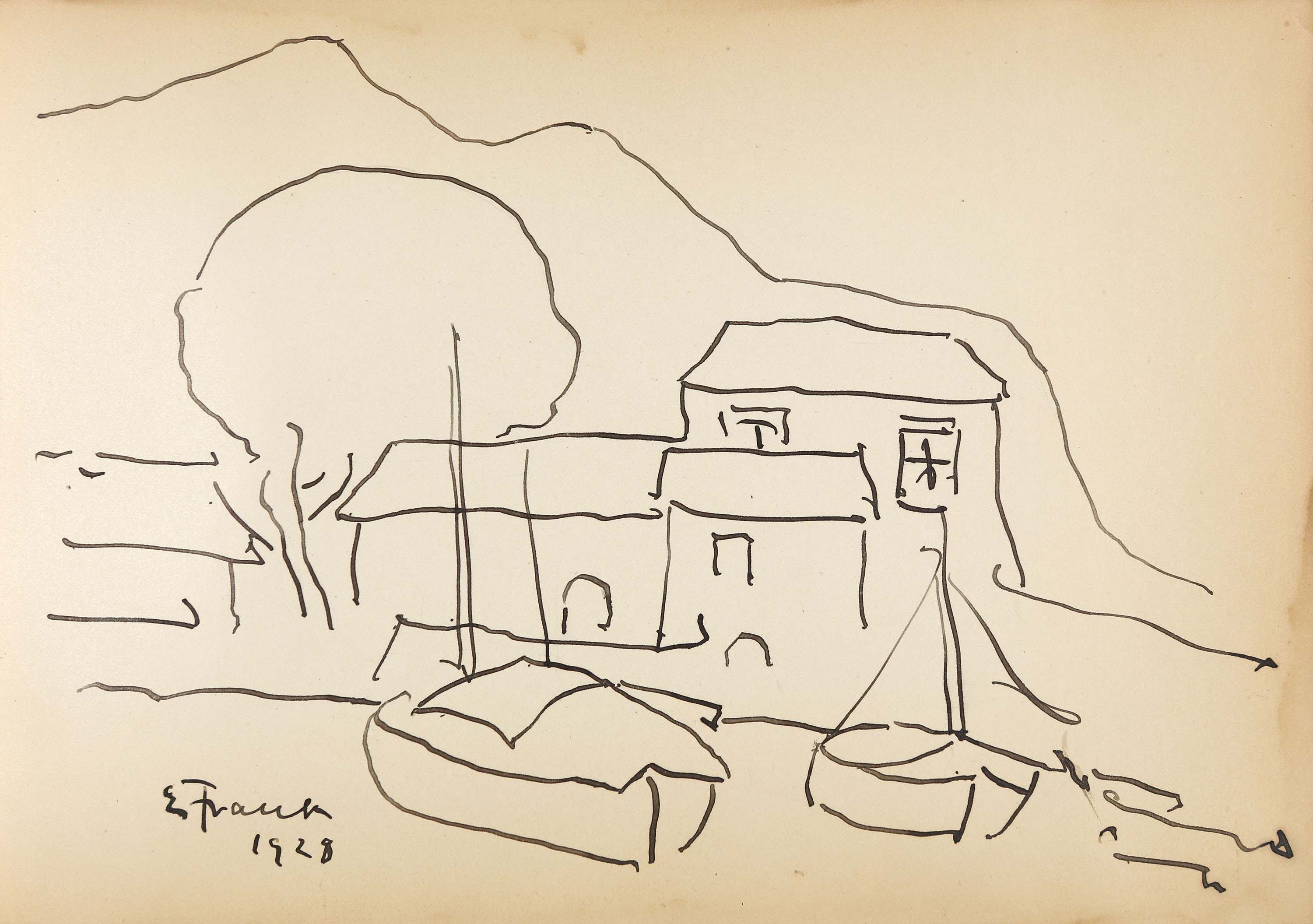
11) Edvard Frank. Ink drawing. 1928. Signed.
12) Iso Elinson. Inscription with handwritten signature. 16 November 1921. Two further inscriptions on the same sheet, one of which is dedicated to ‘Frau Mainzer’.
13) Hermann Stockmann. Ink, washed. Signed.
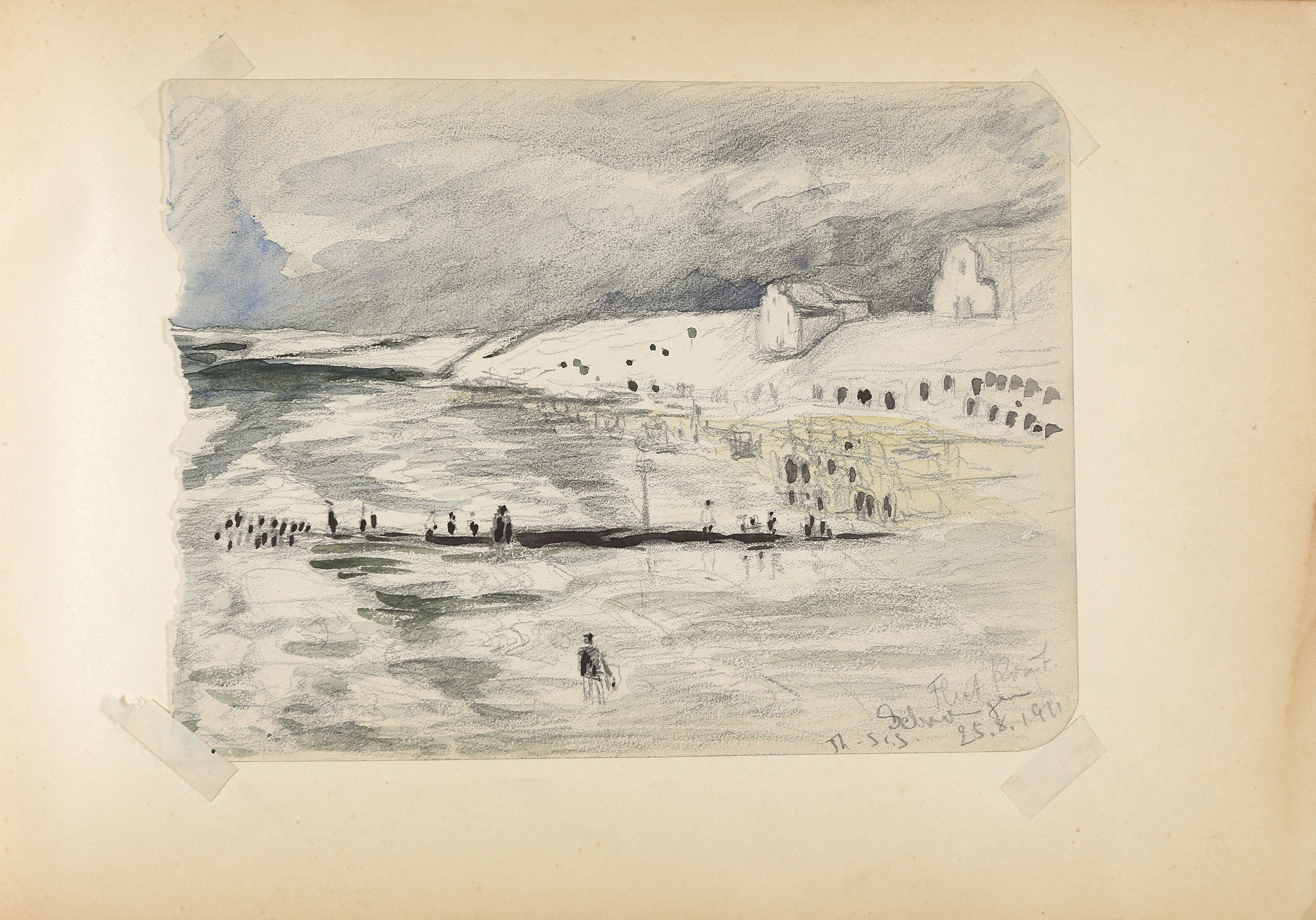
14) Theodor Heuss. ‘Flut kommt’. Watercolour and pencil. 25 August 1911. Monogrammed.
15) Alice Perry Grew. Entry with handwritten signature. 14 August 1911. – Quotation from Shakespeare’s Sonnet 97.
16) Kurt Harald Isenstein. Chalk drawing. May 1931. Signed.
17) Unidentified entry in English (“Chilton”?). 27 February 1913.
18) Theodor Heuss. Charcoal drawing. Monogrammed. On the reverse, the note “from Ferdinand Mainzer’s homeland”. Dedicated to “Frau Kika”, dated and signed February 1928.
19) (Hermann or Emil Stumpp). “Lauffen am Neckar”. Pencil drawing. Signed. Mounted. On the reverse of an envelope addressed to Hermann Stumpp.
20) “Das Urwaldtier”. Drawing and watercolour. Loose, enclosed.
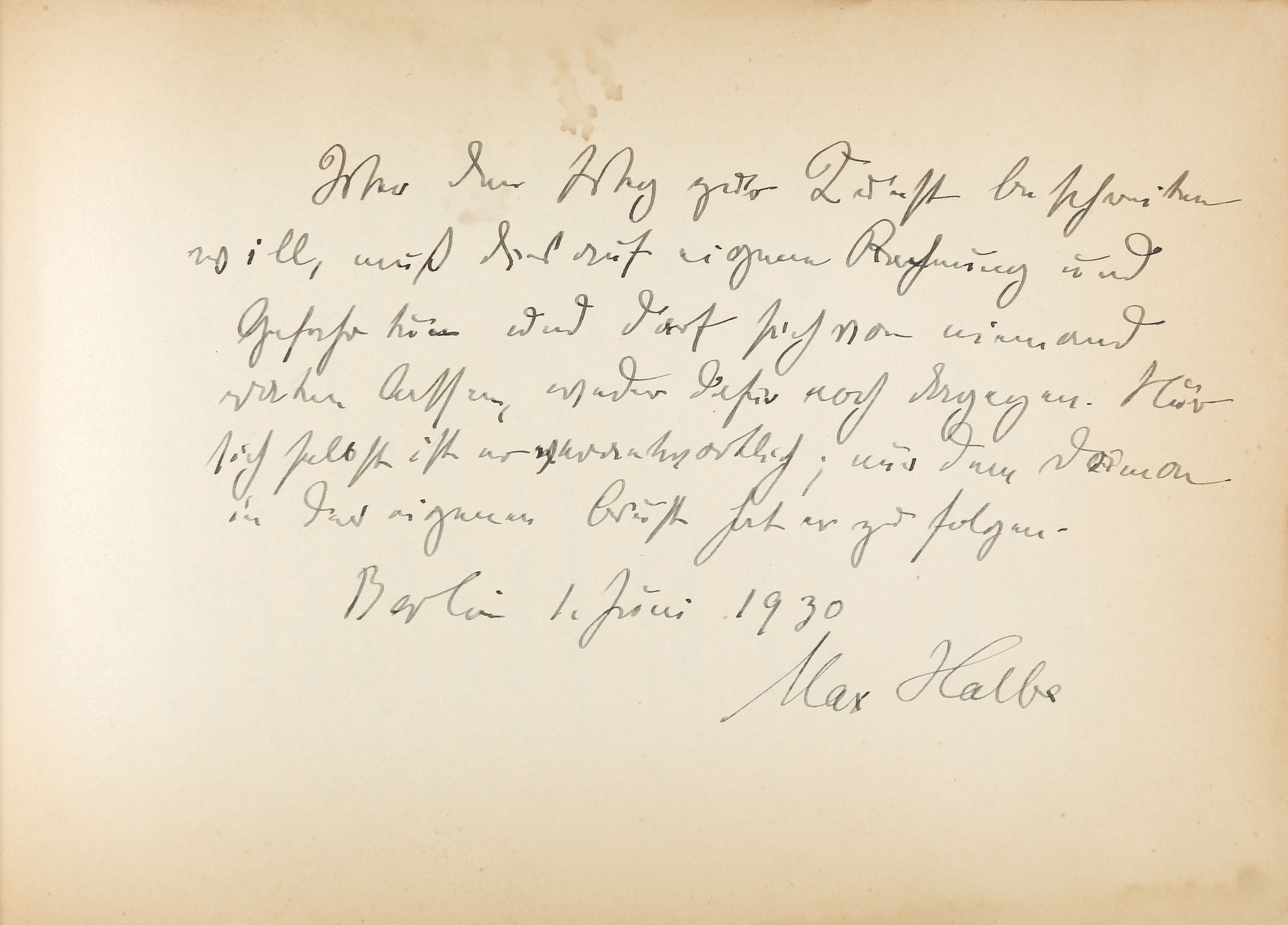
21) Max Halbe. Entry with handwritten signature. Berlin, 1 June 1930. – “Wer den Weg zur Kunst beschreiten will, muß das auf eigene Rechnung und Gefahr tun und darf sich von niemand raten lassen, weder dafür noch dagegen. Nur sich selbst ist er verantwortlich; nur dem Daimon in der eigenen Brust hat er zu folgen”.
22) Therese Benjamin, a friend of the album owner’s mother. Poem with a handwritten signature. 14 March 1931.
23) Unidentified watercolour with ink (Acropolis). Loose sheet enclosed.
24) Elisabeth Müller. Entry with a handwritten signature. Summer 1912.
25) Theodor Heuss and Elly Heuss-Knapp. Handwritten signatures beneath an unidentified entry. Berlin, 5 December 1935.
26) Kurt Harald Isenstein. ‘Zum Jahreswechsel’. Etching. Signed.
27) Unidentified watercolour and pencil on a postcard. Signed on the reverse (‘Sterns’?).
(Rubbed and slightly spotted. A small defect on the front cover. The front cover is warped. The pages are damp-stained throughout, browned and have water-stains in places. Some of the original illustrations have come loose from their mountings and are enclosed separately; some have minor damage to the edges.)
The album provides an unusually detailed account of a personal network of artists, writers, musicians and public figures that developed over several decades. The contributors are largely drawn from Berlin’s artistic and intellectual circles at the turn of the century and during the Weimar Republic, including the wider circle associated with the Berlin Secession. Those represented include, amongst others, George Masson, Wolf Röhricht, Rudolf Hellwag, Julie Wolfthorn, Lovis Corinth, Theodor Heuss, Siegfried Ochs, Max Halbe, Kurt Harald Isenstein and Edvard Frank. The contributions range from handwritten dedications and literary quotations, through musical notations, to watercolours, drawings and prints. The album is therefore of interest not only as a collection of autographs and original works, but also as a rare testament to the close interconnection between the visual arts, literature, music and social life in Berlin during the Imperial era and the Weimar Republic.
Of particular significance are the repeated addresses to a ‘Frau Kika’ or ‘dear Kika’. As far as is currently known, her identity has not been conclusively established. Particularly revealing is the undated entry by the composer Siegfried Ochs, who entrusted ‘his dear Kika’ with the main theme of his then-uncomposed symphony ‘Nebbich’ as a personal ‘secret’ and described himself as the addressee’s ‘old tutor’. Lovis Corinth, too, explicitly dedicated his entry—made in Berlin on 20 November 1922—to ‘Mrs Kika’, as did Theodor Heuss with one of the works contained in the album. Furthermore, there are several notable references to the circle of Ferdinand Mainzer (1871–1943) that shed light on the album’s provenance. On the reverse of a postcard in the album featuring a watercolour by Wolf Röhricht is the address ‘Frau Dr. Mainzer’ (Winterfeldtstr. 5–6, Berlin). The recipient is thought to be Gertrud Mainzer, née Sabersky, the wife of Ferdinand Mainzer. However, it is not possible to identify her with certainty on the basis of this clue alone. Of particular significance, too, is the handwritten note ‘from Ferdinand Mainzer’s home town’ on the reverse of a charcoal drawing by Theodor Heuss. Heuss had a personal connection with Ferdinand Mainzer; at the same time, Mainzer was deeply involved in Berlin’s cultural and intellectual life. Gertrud Mainzer, too, was closely connected to Berlin’s art scene and, as a pupil of Walter Leistikow, had a direct link to the Berlin art world; Lovis Corinth painted portraits of both her and Ferdinand Mainzer. Taken together, these clues provide a plausible provenance trail leading to the Mainzer family circle, although this does not currently allow for a definitive identification of the ‘Frau Kika’ mentioned several times in the album as Gertrud Mainzer. The possibility of a provenance linked to the Mainzer family circle therefore appears plausible; however, it should currently be understood explicitly as a well-founded but not conclusively confirmed hypothesis.
Taken as a whole, the album is to be understood as a stand-alone cultural-historical document of a Berlin network. Its significance lies not only in the prominent list of contributors, but also in the direct visibility of personal relationships:
Original works of art appear alongside private dedications, literary quotations and musical ideas. The album thus preserves an unusually direct snapshot of the social fabric of Berlin Modernism, whilst at the same time revealing the continuity of personal and cultural connections across the turning points of the German Empire, the First World War and the Weimar Republic.
Works included, in the order they appear in the album:
1) George Masson. Watercolour and pencil. 1892. Monogrammed.
2) Wolf Röhricht. Watercolour, ink and pencil. Signed.
3) Rudolf Hellwag. Watercolour and pencil. Signed.
4) George Masson. Watercolour and pencil. 1926. Signed.
5) Theodor Heuss. Watercolour and pencil. 1907. Monogrammed. Enclosed separately.
6) Wolf Röhricht. Watercolour, ink and pencil (Ponte delle Tette, Venice). Monogrammed. On a postcard dated 29 May 1920 addressed to Dr Mainzer, with greetings from Röhricht in Venice.
7) Unidentified entry dated 23 May 1928.
8) Julie Wolfthorn. Woodcut. Signed. With a dedication to ‘Mrs Kika’.
9) Siegfried Ochs. Entry with autograph signature and the main theme of his as yet uncomposed symphony ‘Nebbich’. ‘Confided as a secret to his dear Kika by her old tutor’. Undated.
10) Lovis Corinth. Entry with handwritten signature. Berlin, 20 November 1922. – Quoted from Goethe’s *Faust*: ‘Die Kunst ist lang und kurz ist unser Leben’. Dedicated to ‘Mrs Kika’.
11) Edvard Frank. Ink drawing. 1928. Signed.
12) Iso Elinson. Inscription with handwritten signature. 16 November 1921. Two further inscriptions on the same sheet, one of which is dedicated to ‘Frau Mainzer’.
13) Hermann Stockmann. Ink, washed. Signed.
14) Theodor Heuss. ‘Flut kommt’. Watercolour and pencil. 25 August 1911. Monogrammed.
15) Alice Perry Grew. Entry with handwritten signature. 14 August 1911. – Quotation from Shakespeare’s Sonnet 97.
16) Kurt Harald Isenstein. Chalk drawing. May 1931. Signed.
17) Unidentified entry in English (“Chilton”?). 27 February 1913.
18) Theodor Heuss. Charcoal drawing. Monogrammed. On the reverse, the note “from Ferdinand Mainzer’s homeland”. Dedicated to “Frau Kika”, dated and signed February 1928.
19) (Hermann or Emil Stumpp). “Lauffen am Neckar”. Pencil drawing. Signed. Mounted. On the reverse of an envelope addressed to Hermann Stumpp.
20) “Das Urwaldtier”. Drawing and watercolour. Loose, enclosed.
21) Max Halbe. Entry with handwritten signature. Berlin, 1 June 1930. – “Wer den Weg zur Kunst beschreiten will, muß das auf eigene Rechnung und Gefahr tun und darf sich von niemand raten lassen, weder dafür noch dagegen. Nur sich selbst ist er verantwortlich; nur dem Daimon in der eigenen Brust hat er zu folgen”.
22) Therese Benjamin, a friend of the album owner’s mother. Poem with a handwritten signature. 14 March 1931.
23) Unidentified watercolour with ink (Acropolis). Loose sheet enclosed.
24) Elisabeth Müller. Entry with a handwritten signature. Summer 1912.
25) Theodor Heuss and Elly Heuss-Knapp. Handwritten signatures beneath an unidentified entry. Berlin, 5 December 1935.
26) Kurt Harald Isenstein. ‘Zum Jahreswechsel’. Etching. Signed.
27) Unidentified watercolour and pencil on a postcard. Signed on the reverse (‘Sterns’?).