Lot 1708
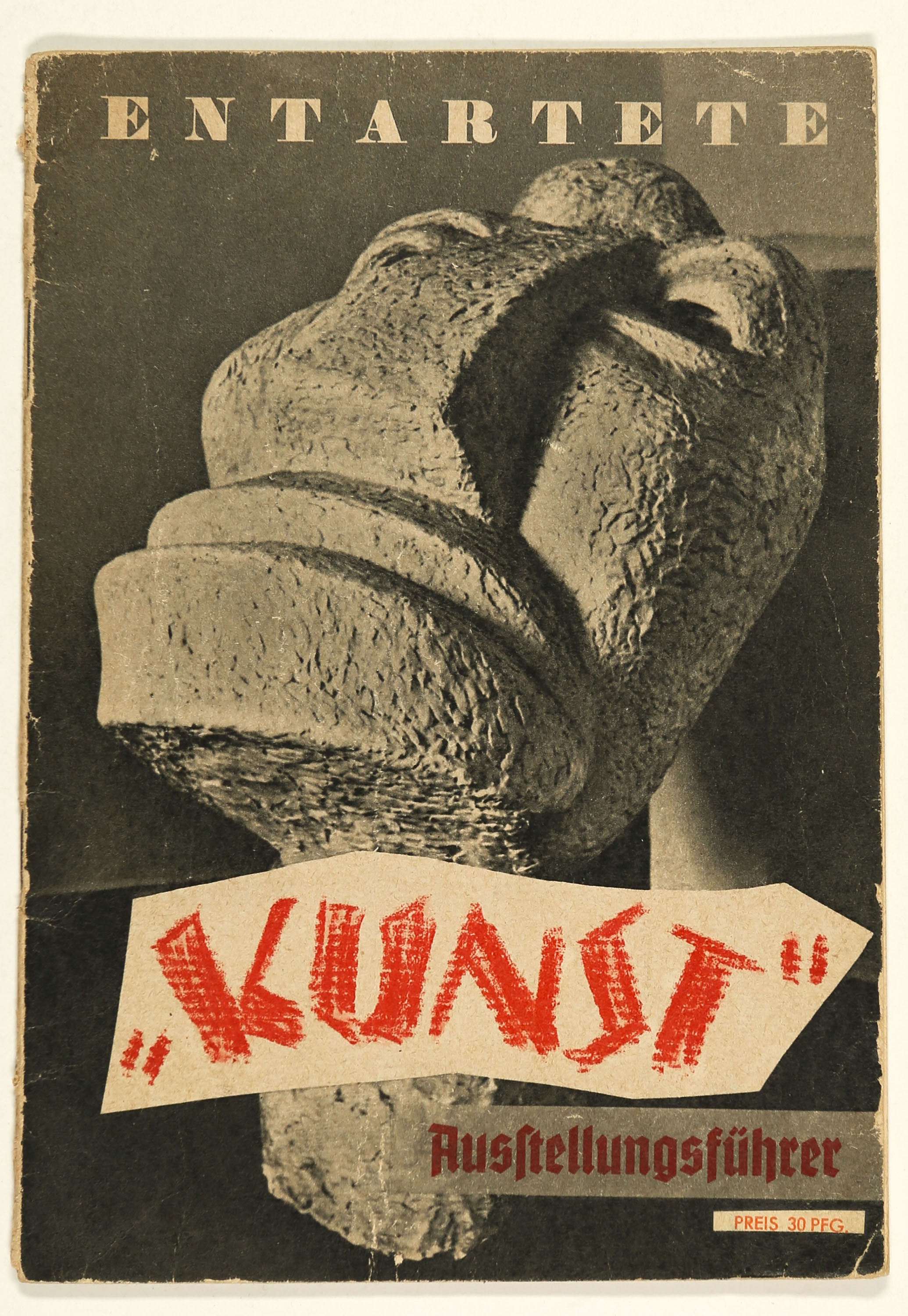
Entartete Kunst. Exhibition guide. (Berlin 1937).
Estimate
€ 300
Starting Price
€ 200
Hammer Price
€ 360
Lot:
1708
Category:
Illustrated Books, portfolios and art literature until 1945
Entartete „Kunst“. Exhibition guide. Berlin: Verlag für Kultur- und Wirtschaftswerbung (1937). 21 x 15 cm. With 57 illustrations (including the cover) in black and white. 30 pages, 1 leaf. Illustrated paperback with staple binding.
(The edges of the cover are scuffed; the bottom corner of the front cover shows a crease; there are small tears. The title page bears a handwritten ownership note, ‘M. Gritzner’, in the top margin. The paper has become brownish with age.)
Barron, S. 356. - Bearing all the characteristics of the first edition described by Hüneke; the price label has been covered with a sticker reading ‘Price 30 Pfg.’ (cf. Barron, p. 356). - The ‘Entartete Kunst’ exhibition, organised by the Nazi art official Adolf Ziegler, opened in Munich on 19 July 1937 and presented around 650 works of classical modernism that had previously been confiscated from 32 German museums. Among the works on display were pieces by Ernst Ludwig Kirchner, Wassily Kandinsky, Paul Klee, Emil Nolde, Otto Dix, Max Beckmann and numerous other avant-garde artists. The aim of this propagandistic exhibition was to publicly defame modern art as an expression of supposed cultural and moral decay. The works were deliberately hung in close proximity to one another, accompanied by derisive comments and polemical wall inscriptions, and torn from their original art-historical context in order to discredit their impact. Fritz Kaiser was responsible for the content of the exhibition catalogue and also formulated the exhibition’s ideological objectives. With over two million visitors, the exhibition became one of the most visited art exhibitions of its time and was subsequently shown in numerous German and Austrian cities. The exhibition catalogue ranks among the key printed works of Nazi art propaganda and serves as a prime example of the cultural and political instrumentalisation of the publishing and exhibition sectors in the ‘Third Reich’.
(The edges of the cover are scuffed; the bottom corner of the front cover shows a crease; there are small tears. The title page bears a handwritten ownership note, ‘M. Gritzner’, in the top margin. The paper has become brownish with age.)
Barron, S. 356. - Bearing all the characteristics of the first edition described by Hüneke; the price label has been covered with a sticker reading ‘Price 30 Pfg.’ (cf. Barron, p. 356). - The ‘Entartete Kunst’ exhibition, organised by the Nazi art official Adolf Ziegler, opened in Munich on 19 July 1937 and presented around 650 works of classical modernism that had previously been confiscated from 32 German museums. Among the works on display were pieces by Ernst Ludwig Kirchner, Wassily Kandinsky, Paul Klee, Emil Nolde, Otto Dix, Max Beckmann and numerous other avant-garde artists. The aim of this propagandistic exhibition was to publicly defame modern art as an expression of supposed cultural and moral decay. The works were deliberately hung in close proximity to one another, accompanied by derisive comments and polemical wall inscriptions, and torn from their original art-historical context in order to discredit their impact. Fritz Kaiser was responsible for the content of the exhibition catalogue and also formulated the exhibition’s ideological objectives. With over two million visitors, the exhibition became one of the most visited art exhibitions of its time and was subsequently shown in numerous German and Austrian cities. The exhibition catalogue ranks among the key printed works of Nazi art propaganda and serves as a prime example of the cultural and political instrumentalisation of the publishing and exhibition sectors in the ‘Third Reich’.