Lot 941
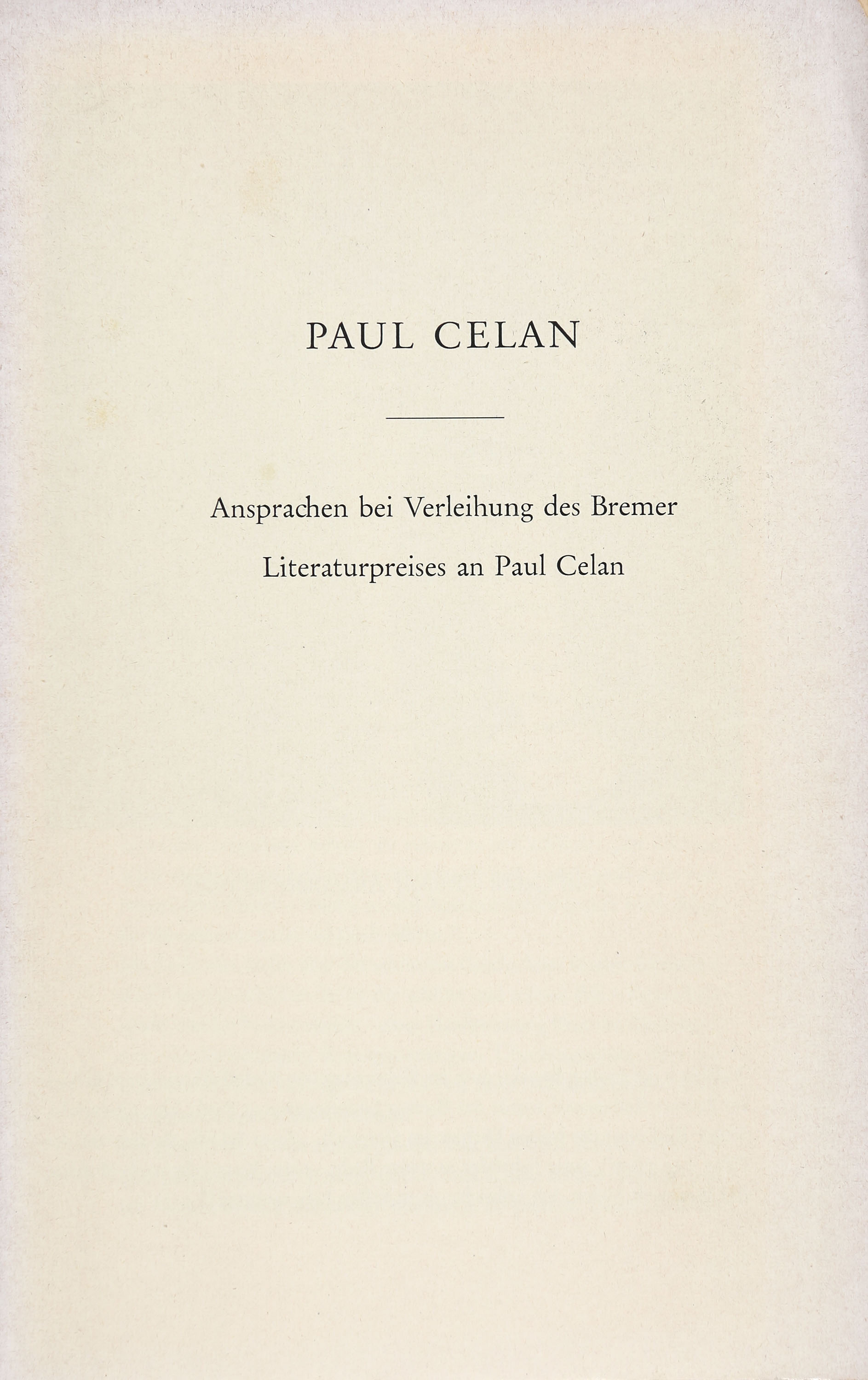
Paul Celan. Ansprachen bei Verleihung des Bremer Literaturpreises. (1958).
Estimate
€ 200
Starting Price
€ 140
Hammer Price
€ 140
Lot:
941
Category:
Literature of the 20th century
Paul Celan. Ansprachen bei Verleihung des Bremer Literaturpreises an Paul Celan. 21 x 13,5 cm. 11 pp. in staple binding.
(Slightly browned. Upper corners slightly creased; a small tear on p. 1.)
A publication marking the awarding of the Bremen Literature Prize to Paul Celan, who was honoured in 1958 for “Mohn und Gedächtnis” and “Von Schwelle zu Schwelle”. It contains the address by the writer and librarian Erhart Kästner, as well as Celan’s own acceptance speech. Particularly noteworthy is the historical tension inherent in this constellation: Kästner, who had distinguished himself during the Nazi era as a writer and a volunteer in the war effort, is here paying tribute to the Jewish poet Paul Celan, whose parents were murdered in the Holocaust and whose poetry is profoundly shaped by the experience of the Shoah. It is striking that Kästner’s speech does not explicitly address this historical dimension, but focuses entirely on the linguistic distinctiveness and poetic significance of Celan’s work. Kästner hints at an awareness of the biographical connections, but takes refuge in his supposed ignorance: ‘Und dann finde ich auch, daß diese Gedichte Schicksale tragen und haben. Ich meine jetzt nicht, daß sie Biographie haben, von der ich nichts weiß, die wohl dasein kann, aber ich kann es nicht wissen, sie ist in jedem Falle weit weg, außer Ruf-, außer Hörweite. Ich meine also nicht einen Lebenstoff, den ich nicht kenne, aber ich spüre, daß so etwas da ist, ich spüre eine Last, ein Gewicht, einen Mut, eine Trauer, spüre Überwindung und Drängen und Treiben. Es kann gut sein, daß ich dieses und jenes Gedicht falsch verstehe, in der Weise, wie ich es zu hören, zu lesen, mir auszulegen versuche; kann sein, daß ich es ziemlich anders verstehe, als es gemeint ist, und so wird es auch anderen gehen” (p. 9). Celan’s speech, on the other hand, clearly addresses the losses and unattainabilities which only language was able to help him overcome. Thus, this slim volume becomes an illuminating document of the West German literary public’s difficult engagement with its own Nazi past. It is a significant testament to Celan’s public recognition and the ambivalences of post-war literary culture.
(Slightly browned. Upper corners slightly creased; a small tear on p. 1.)
A publication marking the awarding of the Bremen Literature Prize to Paul Celan, who was honoured in 1958 for “Mohn und Gedächtnis” and “Von Schwelle zu Schwelle”. It contains the address by the writer and librarian Erhart Kästner, as well as Celan’s own acceptance speech. Particularly noteworthy is the historical tension inherent in this constellation: Kästner, who had distinguished himself during the Nazi era as a writer and a volunteer in the war effort, is here paying tribute to the Jewish poet Paul Celan, whose parents were murdered in the Holocaust and whose poetry is profoundly shaped by the experience of the Shoah. It is striking that Kästner’s speech does not explicitly address this historical dimension, but focuses entirely on the linguistic distinctiveness and poetic significance of Celan’s work. Kästner hints at an awareness of the biographical connections, but takes refuge in his supposed ignorance: ‘Und dann finde ich auch, daß diese Gedichte Schicksale tragen und haben. Ich meine jetzt nicht, daß sie Biographie haben, von der ich nichts weiß, die wohl dasein kann, aber ich kann es nicht wissen, sie ist in jedem Falle weit weg, außer Ruf-, außer Hörweite. Ich meine also nicht einen Lebenstoff, den ich nicht kenne, aber ich spüre, daß so etwas da ist, ich spüre eine Last, ein Gewicht, einen Mut, eine Trauer, spüre Überwindung und Drängen und Treiben. Es kann gut sein, daß ich dieses und jenes Gedicht falsch verstehe, in der Weise, wie ich es zu hören, zu lesen, mir auszulegen versuche; kann sein, daß ich es ziemlich anders verstehe, als es gemeint ist, und so wird es auch anderen gehen” (p. 9). Celan’s speech, on the other hand, clearly addresses the losses and unattainabilities which only language was able to help him overcome. Thus, this slim volume becomes an illuminating document of the West German literary public’s difficult engagement with its own Nazi past. It is a significant testament to Celan’s public recognition and the ambivalences of post-war literary culture.