Lot 707
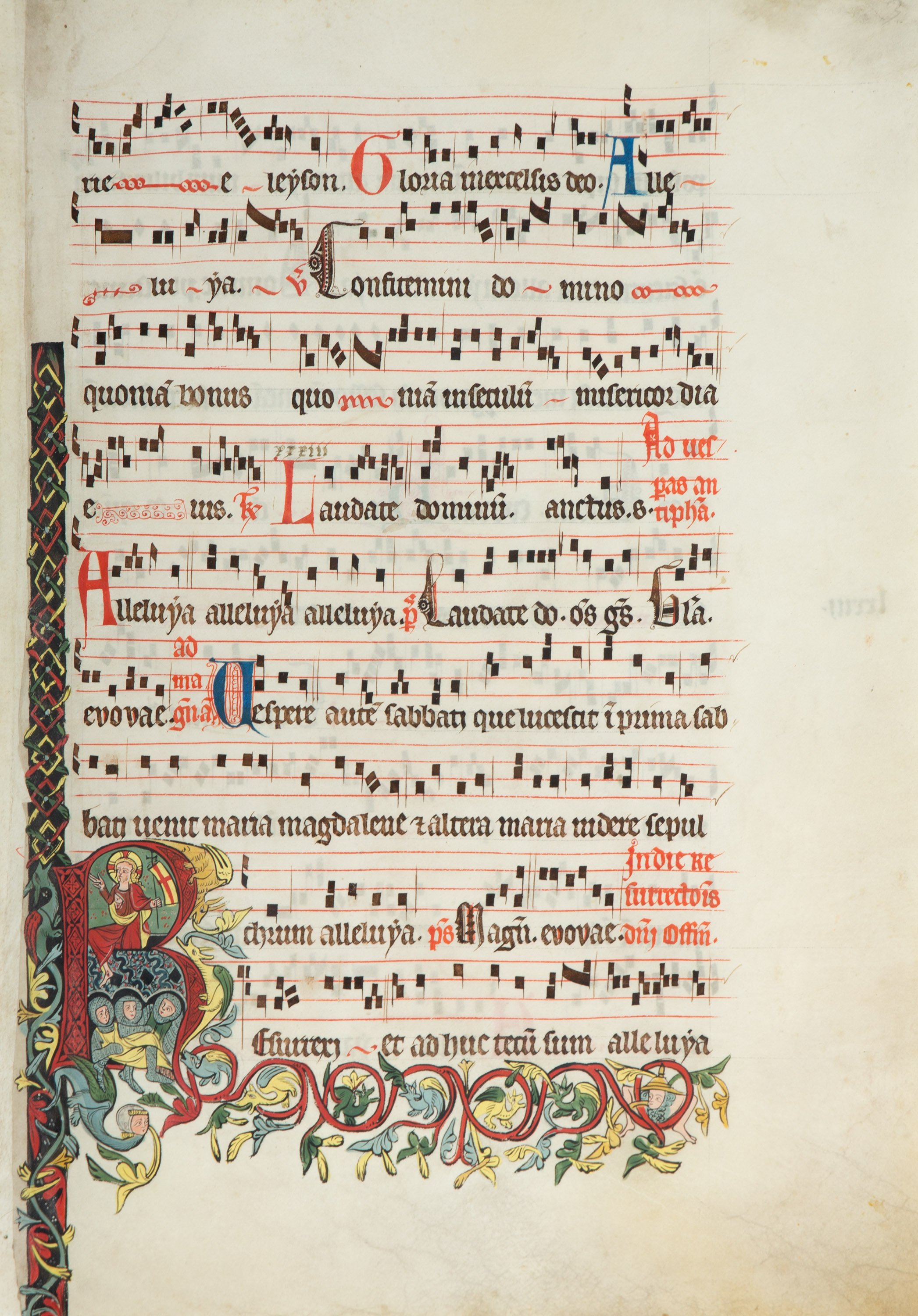
Antiphonary. – A single leaf from an antiphonary featuring a large historicised initial ‘R’. (Upper Rhine), first half of the 14th century.
Estimate
€ 3.000
Starting Price
€ 2.000
Hammer Price
€ 4.200
Lot:
707
Category:
Manuscripts and autographs
Antiphonary. – A single leaf from an antiphonary featuring a large historicised initial ‘R’ and marginal decoration. (Upper Rhine), first half of the 14th century.
(Mounted on a passe-partout on the reverse at the top edge using two adhesive strips. Corners and edges slightly darkened or dusty. Minimal age-related staining and wear.)
Parchment. 422 x 297 mm. Musical and text area approx. 293 x 205 mm. Four-line staves on both sides in red with dark brown square notation. Text in dark brown Textura. Lombardic letters in red, blue and brown. Text markings in red. On the recto, a large initial ‘R’ marking the incipit of the Introit for Easter Sunday (‘Resurrexi et adhuc teum sum alleluya’). The letter body is in red on a black ground with ornamental decoration within the stem, arch and tail. Within this, in opaque colours, the Resurrection scene: in the upper part of the letter, against a green background, the Risen Christ in a red robe with a yellow stole and visible stigmata, holding a banner of victory in yellow and red in his left hand and raising his right hand in a gesture of blessing. In the lower part, the open tomb with the three Roman guards. Springing from the stem of the letter is a seven-fold coiled tendril in red with acanthus tendrils in green, yellow and grey. In the spaces between the first six coils of the tendril, there is a dragon-like creature in each; in the space between the final coil, a grotesque human figure with shoulder bones. On the outer arch and leg, two further dragon-like creatures spewing acanthus leaves are perched. Along the left edge of the leaf, a 307 mm long border on a black ground, in the centre of which multicoloured, overlapping diamond shapes emerge from the mouth of a long-tailed dragon; towards the lower edge, the dragon’s tail is interwoven with acanthus leaves in red, yellow and grey. Perched beneath the shaft and upon the tail of the border dragon is a hybrid creature with a grey dragon’s body, green wings and a female human head, from whose mouth—just like that of the grotesque figure—acanthus tendrils emerge.
(Mounted on a passe-partout on the reverse at the top edge using two adhesive strips. Corners and edges slightly darkened or dusty. Minimal age-related staining and wear.)
Parchment. 422 x 297 mm. Musical and text area approx. 293 x 205 mm. Four-line staves on both sides in red with dark brown square notation. Text in dark brown Textura. Lombardic letters in red, blue and brown. Text markings in red. On the recto, a large initial ‘R’ marking the incipit of the Introit for Easter Sunday (‘Resurrexi et adhuc teum sum alleluya’). The letter body is in red on a black ground with ornamental decoration within the stem, arch and tail. Within this, in opaque colours, the Resurrection scene: in the upper part of the letter, against a green background, the Risen Christ in a red robe with a yellow stole and visible stigmata, holding a banner of victory in yellow and red in his left hand and raising his right hand in a gesture of blessing. In the lower part, the open tomb with the three Roman guards. Springing from the stem of the letter is a seven-fold coiled tendril in red with acanthus tendrils in green, yellow and grey. In the spaces between the first six coils of the tendril, there is a dragon-like creature in each; in the space between the final coil, a grotesque human figure with shoulder bones. On the outer arch and leg, two further dragon-like creatures spewing acanthus leaves are perched. Along the left edge of the leaf, a 307 mm long border on a black ground, in the centre of which multicoloured, overlapping diamond shapes emerge from the mouth of a long-tailed dragon; towards the lower edge, the dragon’s tail is interwoven with acanthus leaves in red, yellow and grey. Perched beneath the shaft and upon the tail of the border dragon is a hybrid creature with a grey dragon’s body, green wings and a female human head, from whose mouth—just like that of the grotesque figure—acanthus tendrils emerge.