Lot 674
V. Ferrerius, Sermones de tempore. Pars hiemalis. Nürnberg 1492. - Attached: V. Ferrerius, Sermones de sanctis. Nürnberg, 28.VI.1492.
Estimate
€ 3.000
Starting Price
€ 2.000
Hammer Price
€ 2.400
Lot:
674
Category:
Old prints up to 1600
Author:
Vincentius Ferrerius
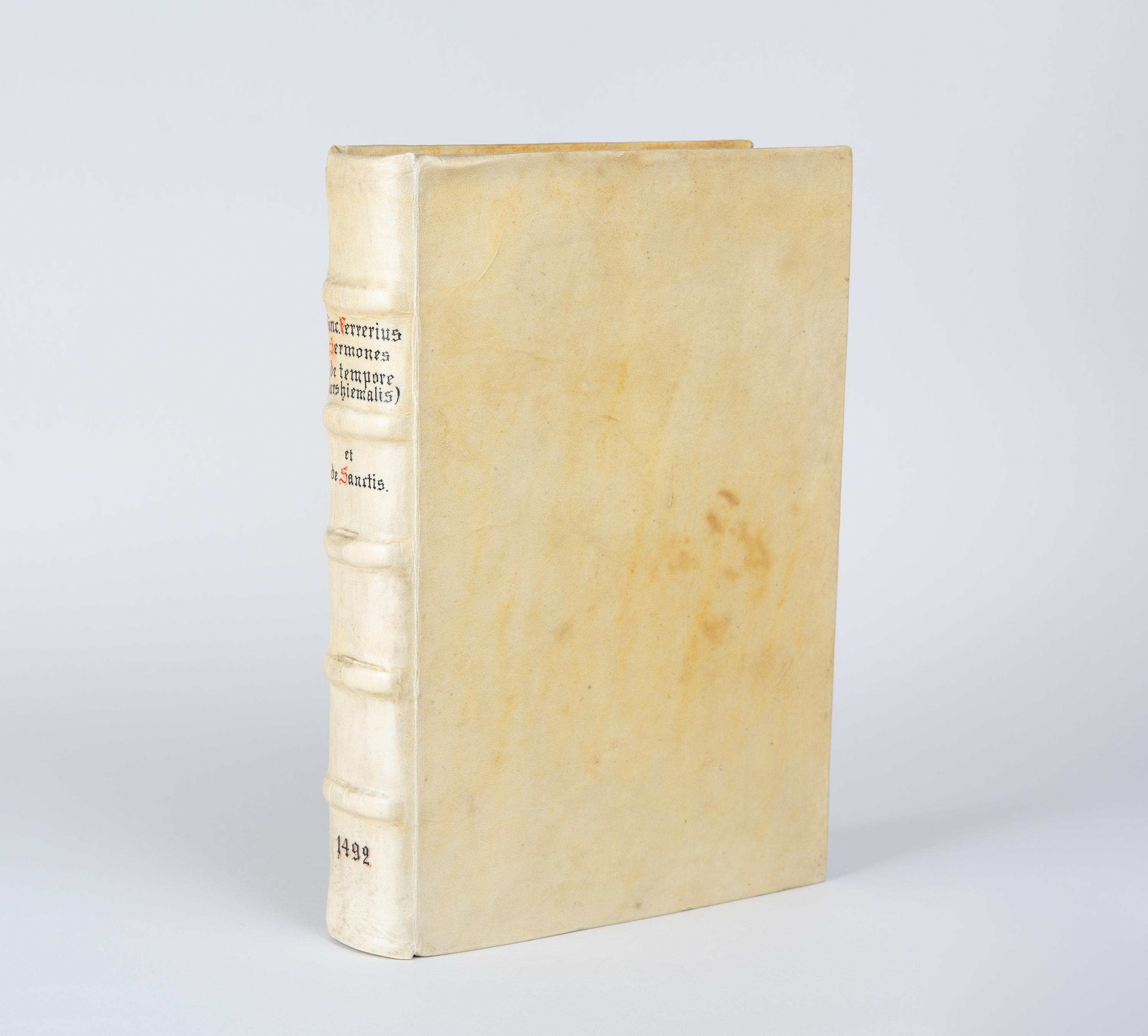
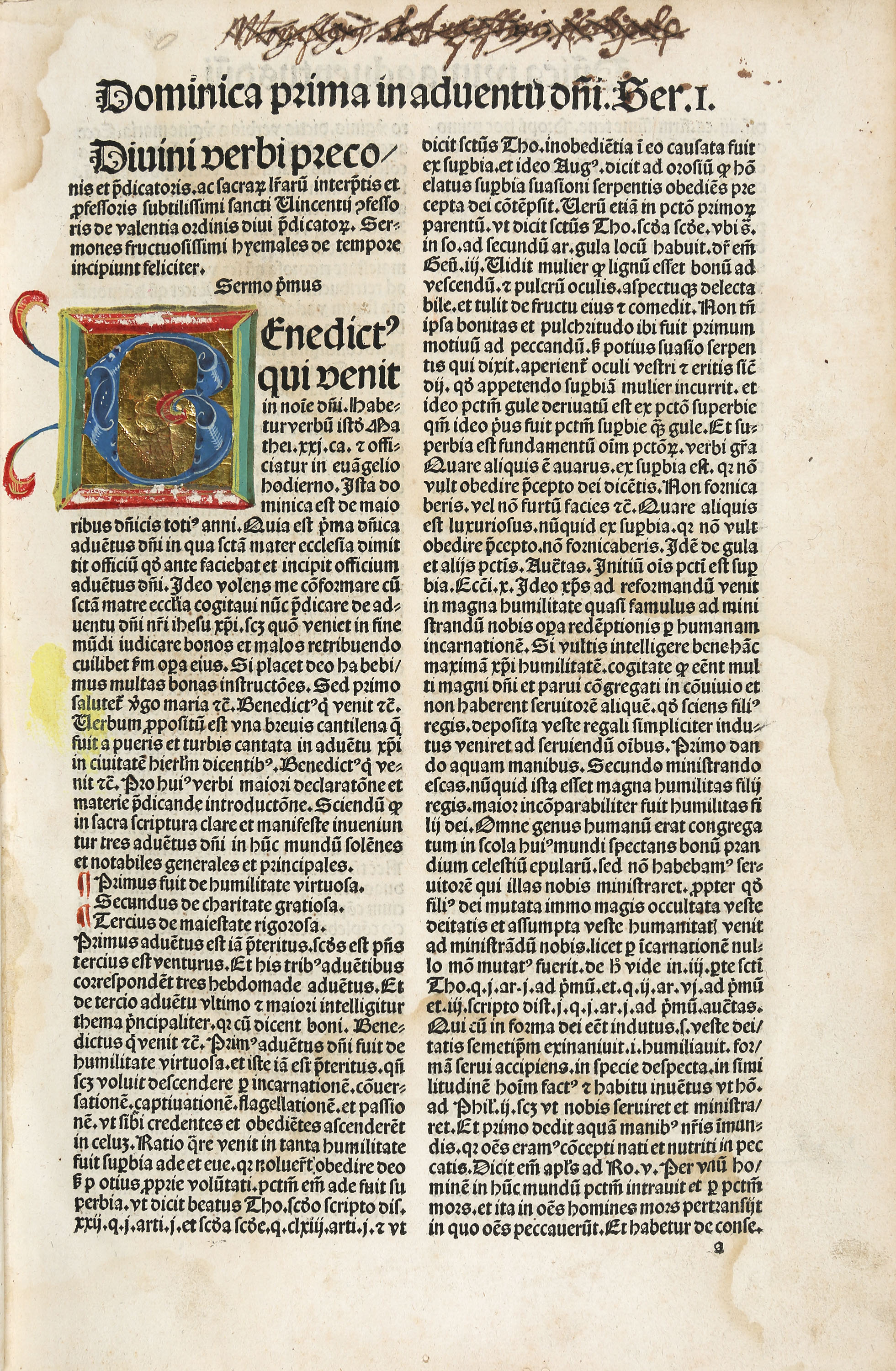
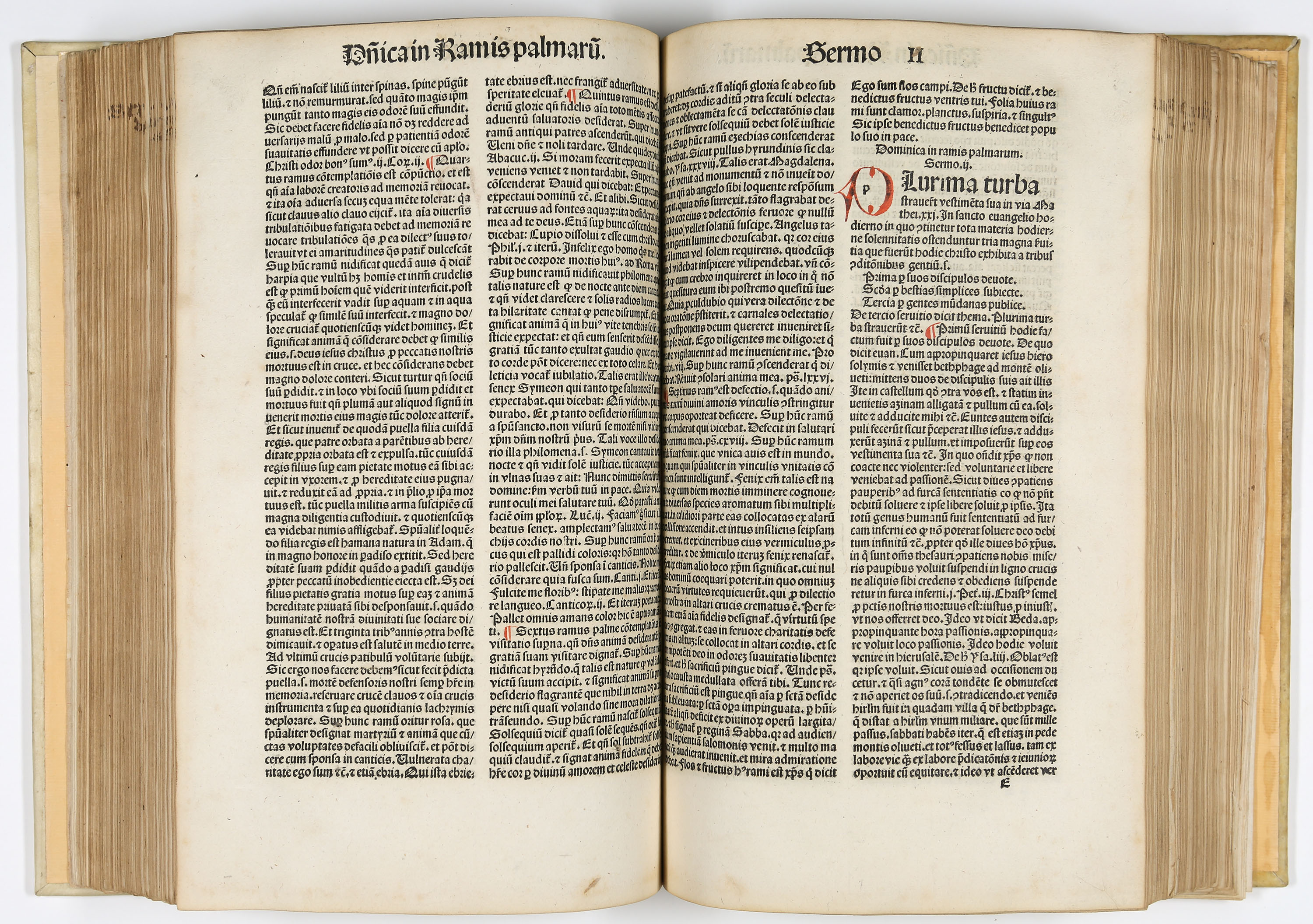
Ferrerius, Vincentius: Sermones de tempore. Pars hiemalis (und) Sermones de sanctis. 2 parts (of 3) in 1 vol. Nürnberg: (Anton Koberger) 1492. 29,2 x 19,8 cm. Featuring a multi-line blue initial ‘B’ on a gold background. 207 (of 208) unnumbered pages, 135 unnumbered leaves, 1 blank leaf. Gothic typeface, printed in two columns of 55 lines each. Rubricated throughout and featuring blue and red initials. Modern parchment binding with handwritten spine title.
(The title page of the ‘Sermones de tempore’ is missing. Edges with handwritten title. Folio a¹ has a crossed-out owner’s mark in the top margin. Water-stained throughout. With a few marginal notes and underlinings in ink. The last two quires show wormholes within the text block and minor loss of text. Slightly discoloured.)
BSB-Ink. F-89. Goff F-134. GW 9840. Hain 7008 I und III. - A Nuremberg incunabulum containing two parts of the great collection of sermons by St Vincent Ferrer. Printed at Anton Koberger’s famous printing house, which was one of the most productive of its time. The *Pars hiemalis* brings together the sermons for the winter part of the church year, whilst the *Sermones de sanctis* are devoted to the feasts of the saints. Thus, two essential dimensions of contemporary homiletic literature come together here: the interpretation of the liturgical year and the proclamation of the Gospel through the veneration of the saints. - The Dominican Vincent Ferrer (1350–1419), a native of Valencia, was one of the most prominent and influential preachers of the late European Middle Ages. Even during his lifetime, he enjoyed a reputation as a charismatic penitent preacher, whose itinerant sermons drew large crowds and whose preaching had an impact far beyond the borders of the Iberian Peninsula. Ferrer preached in Castile, Aragon, southern France, Italy and other parts of Europe, and dedicated his life to the forceful proclamation of penance, conversion and the Christian way of life. In 1455, he was canonised by Pope Calixtus III.
(The title page of the ‘Sermones de tempore’ is missing. Edges with handwritten title. Folio a¹ has a crossed-out owner’s mark in the top margin. Water-stained throughout. With a few marginal notes and underlinings in ink. The last two quires show wormholes within the text block and minor loss of text. Slightly discoloured.)
BSB-Ink. F-89. Goff F-134. GW 9840. Hain 7008 I und III. - A Nuremberg incunabulum containing two parts of the great collection of sermons by St Vincent Ferrer. Printed at Anton Koberger’s famous printing house, which was one of the most productive of its time. The *Pars hiemalis* brings together the sermons for the winter part of the church year, whilst the *Sermones de sanctis* are devoted to the feasts of the saints. Thus, two essential dimensions of contemporary homiletic literature come together here: the interpretation of the liturgical year and the proclamation of the Gospel through the veneration of the saints. - The Dominican Vincent Ferrer (1350–1419), a native of Valencia, was one of the most prominent and influential preachers of the late European Middle Ages. Even during his lifetime, he enjoyed a reputation as a charismatic penitent preacher, whose itinerant sermons drew large crowds and whose preaching had an impact far beyond the borders of the Iberian Peninsula. Ferrer preached in Castile, Aragon, southern France, Italy and other parts of Europe, and dedicated his life to the forceful proclamation of penance, conversion and the Christian way of life. In 1455, he was canonised by Pope Calixtus III.